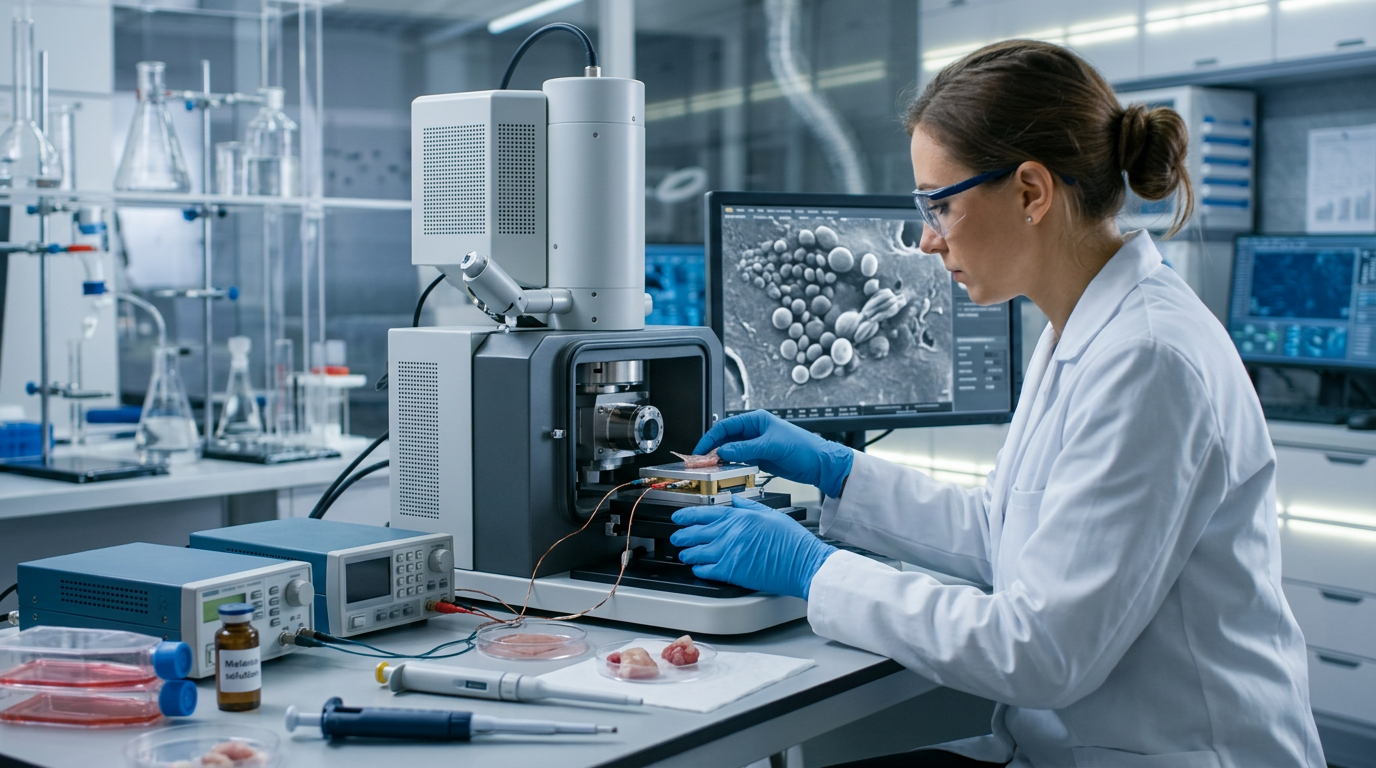
Recent investigations into melanin's biophysical properties suggest this ubiquitous biological pigment may respond to mechanical forces in ways that could revolutionize our understanding of cellular signaling. If melanin exhibits piezoelectric-like behavior, sound waves and mechanical vibrations could directly influence biological processes through charge separation mechanisms. This emerging hypothesis bridges acoustics, materials science, and cellular biology in unexpected ways.
The human body hums with mechanical energy. Every heartbeat, muscle contraction, and sound wave creates vibrations that ripple through tissues at frequencies ranging from infrasonic pulses below 20 Hz to ultrasonic waves exceeding 20 kHz. For decades, scientists have documented how cells respond to mechanical stimuli through established mechanotransduction pathways involving stretch-activated ion channels and cytoskeletal networks. But what if there's another player in this mechanical symphony—one that's been hiding in plain sight within the dark granules of melanin?
Recent materials science research has revealed that melanin possesses remarkable electrical properties that extend far beyond its traditional role as a photoprotective pigment. The polymer exhibits semiconductor behavior with a bandgap around 1.85 eV, displays stable free radical populations detectable by electron paramagnetic resonance spectroscopy, and shows hydration-dependent conductivity that can vary by orders of magnitude. These properties have led researchers to investigate whether melanin might also respond to mechanical forces in ways that could influence cellular function.
The Piezoelectric Connection in Biological Systems
Piezoelectricity—the generation of electrical charge in response to mechanical stress—is well-established in biological materials. Collagen, the most abundant protein in the human body, exhibits clear piezoelectric properties that contribute to bone remodeling and wound healing processes. When collagen fibers are mechanically deformed, they generate measurable electrical potentials that can influence nearby cells.
The molecular structure of melanin suggests it could exhibit similar mechanically-responsive electrical behavior. Eumelanin, the predominant form found in human skin and brain tissue, consists of polymerized units of 5,6-dihydroxyindole (DHI) and 5,6-dihydroxyindole-2-carboxylic acid (DHICA) arranged in complex, partially ordered structures. These aromatic polymer chains contain extensive π-electron systems and numerous hydroxyl groups that could respond to mechanical deformation through charge redistribution.
Computational studies of melanin's molecular dynamics have shown that mechanical stress can alter the spatial arrangement of these polymer chains, potentially affecting their electronic properties. When melanin granules are compressed or stretched, the changing intermolecular distances could modify electron delocalization patterns, creating transient electrical fields within the cellular environment.
Acoustic Stimulation and Cellular Response Mechanisms
The implications become particularly intriguing when considering acoustic stimulation of melanin-containing tissues. Sound waves represent organized mechanical energy that could theoretically interact with melanin granules in a frequency-dependent manner. Different acoustic frequencies might selectively activate melanin populations based on their size, organization, or local mechanical environment.
Research in ultrasonic therapy has demonstrated that mechanical vibrations can influence cellular metabolism, gene expression, and tissue healing rates. While most studies attribute these effects to cavitation, heating, or direct membrane perturbation, the presence of mechanically-responsive melanin could provide an additional pathway for acoustic-biological interactions.
The substantia nigra region of the brain, which contains high concentrations of neuromelanin, presents a particularly compelling case study. This region's neurons are exquisitely sensitive to environmental factors and show altered electrical activity in various neurological conditions. If neuromelanin responds to mechanical vibrations—whether from external sound sources, cerebrospinal fluid pulsations, or vascular rhythms—this could represent a previously unrecognized mechanism for environmental influences on brain function.
Charge Separation and Bioelectric Signaling Integration
The concept of vibration-induced charge separation in melanin granules opens fascinating possibilities for integration with established bioelectric signaling pathways. Michael Levin's research at Tufts University has demonstrated that bioelectric patterns—created by ion gradients across cell membranes—serve as instructive signals for development, regeneration, and disease processes. Cells use these electrical patterns as a form of biological computation, processing information about their environment and coordinating complex multicellular behaviors.
If mechanical vibrations can induce charge separation in melanin, this could create localized electrical fields that interact with membrane voltage patterns. Melanin granules are often positioned near cell membranes and organelles, placing them in ideal locations to influence bioelectric signaling networks. The resulting mechanically-induced bioelectric modulation could provide cells with additional information channels for environmental sensing and response.
This mechanism might be particularly relevant in tissues that experience regular mechanical stress, such as skin exposed to sound vibrations, muscle tissue during contraction, or neural tissue subject to cerebrospinal fluid pulsations. The frequency-dependent nature of piezoelectric responses could allow cells to distinguish between different types of mechanical inputs and respond appropriately.
Implications for Therapeutic Applications and Future Research
The piezoelectric hypothesis for melanin function suggests several testable predictions that could guide future research. Melanin-rich tissues should show frequency-dependent responses to acoustic stimulation that correlate with charge generation rather than thermal effects. Cells with higher melanin content might display enhanced mechanosensitivity compared to melanin-depleted controls. Most importantly, the electrical responses should be measurable using techniques like patch-clamp electrophysiology or bioelectric imaging.
These investigations could reveal new therapeutic targets for conditions involving melanin-rich tissues. Acoustic therapies might be optimized based on melanin content and distribution patterns. Neurological conditions affecting the substantia nigra might benefit from precisely tuned mechanical stimulation protocols designed to support healthy bioelectric signaling patterns.
The research also raises intriguing questions about evolutionary advantages of mechanically-responsive melanin. Did this property evolve as a way for organisms to sense and respond to acoustic environments? Could it explain some of the complex relationships between sound exposure and biological function that have been observed but not fully understood?
Key Takeaways
• Melanin's semiconductor properties and complex molecular structure suggest it could exhibit piezoelectric-like responses to mechanical deformation, generating electrical charges when subjected to vibrations or acoustic waves.
• The substantia nigra and other melanin-rich brain regions could be particularly sensitive to mechanical stimulation, potentially providing a new mechanism for environmental influences on neural function through neuromelanin activation.
• Frequency-dependent charge separation in melanin granules could create localized electrical fields that interact with established bioelectric signaling pathways, adding new layers of cellular information processing.
• This hypothesis predicts that acoustic therapies could be optimized based on tissue melanin content and that melanin-rich cells should show enhanced mechanosensitivity compared to melanin-depleted controls.
• Integration of mechanically-responsive melanin with bioelectric signaling networks could explain previously mysterious relationships between sound exposure and biological function across multiple organ systems.
• Future research should focus on directly measuring electrical responses in melanin-containing tissues during controlled acoustic stimulation to test the fundamental predictions of this emerging hypothesis.
References
McGinness, J., Corry, P., & Proctor, P. "Amorphous semiconductor switching in melanins." Science 183(4127), 853-855 (1974).
Levin, M. "Bioelectric signaling: Reprogrammable circuits underlying embryogenesis, regeneration, and cancer." Cell 184(8), 1971-1989 (2021).
Meredith, P., & Sarna, T. "The physical and chemical properties of eumelanin." Pigment Cell Research 19(6), 572-594 (2006).
Mostert, A. B., et al. "Role of semiconductivity and ion transport in the electrical conduction of melanin." Proceedings of the National Academy of Sciences 109(23), 8943-8947 (2012).
Fukada, E., & Yasuda, I. "On the piezoelectric effect of bone." Journal of the Physical Society of Japan 12(10), 1158-1162 (1957).
d'Ischia, M., et al. "Melanins and melanogenesis: from pigment cells to human health and technological applications." Pigment Cell & Melanoma Research 28(5), 520-544 (2015).
Zecca, L., et al. "Neuromelanin can protect against iron-mediated oxidative damage in system modeling iron overload of brain aging and Parkinson's disease." Journal of Neurochemistry 106(4), 1866-1875 (2008).