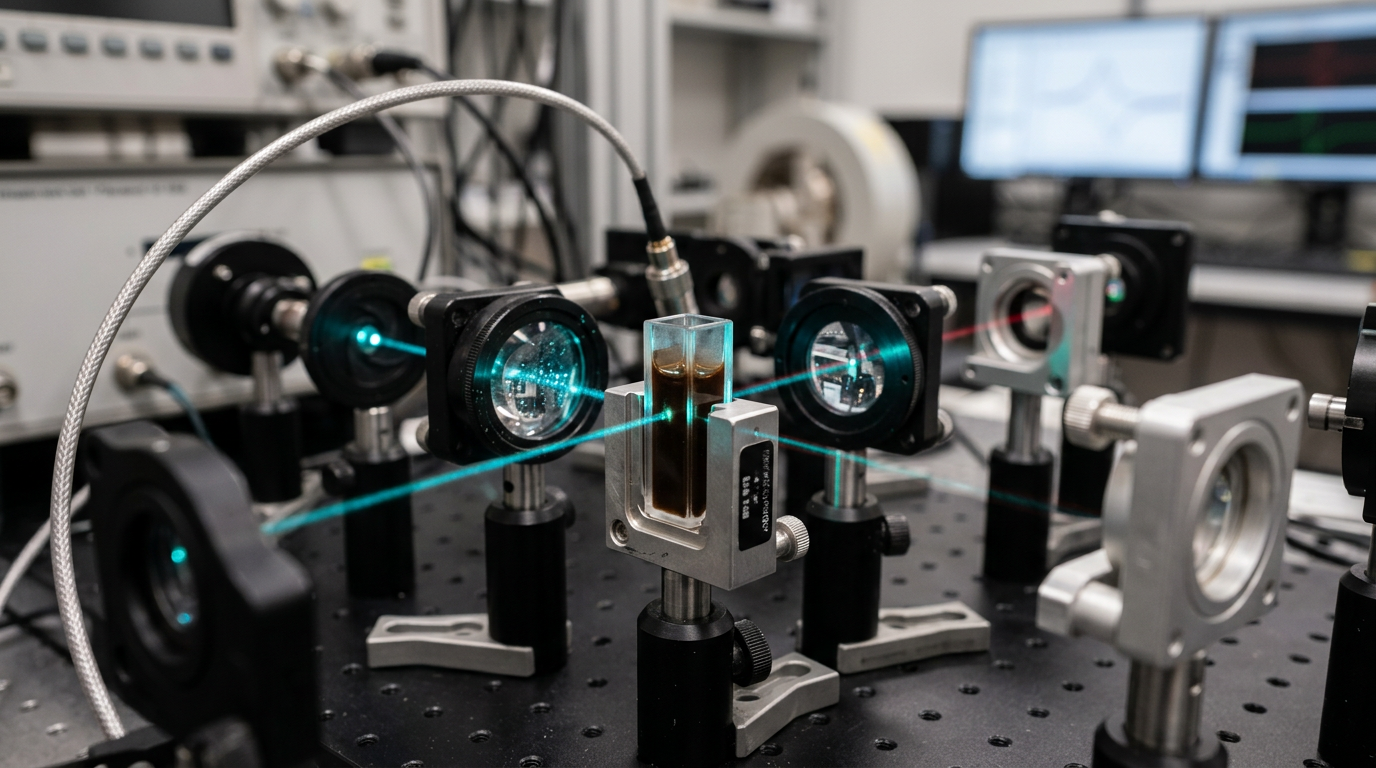
Melanin's stable free radicals, detectable by electron paramagnetic resonance spectroscopy for decades after formation, may represent nature's first discovered biological quantum memory system. These persistent spin states could encode and preserve information at the molecular level, challenging our understanding of how biological systems process and store data.
The human brain contains approximately 400,000 neurons packed with neuromelanin in the substantia nigra, each one harboring billions of stable free radical sites that persist for decades. Unlike the fleeting radical intermediates that typically last nanoseconds in biological systems, melanin's semiquinone radicals maintain their unpaired electron spins for months or even years. This extraordinary stability, first documented by electron paramagnetic resonance (EPR spectroscopy) in the 1960s, represents one of biology's most puzzling phenomena—and potentially one of its most sophisticated information storage mechanisms.
Recent advances in quantum biology have revealed that nature routinely exploits quantum mechanical properties for biological function, from the coherent energy transfer in photosynthesis to the quantum entanglement in avian magnetoreception. Against this backdrop, melanin's persistent radical population takes on new significance. These stable spins may not be metabolic byproducts or protective antioxidants, but rather the hardware for a biological quantum memory system operating in the warm, wet environment of living tissue.
The Radical Landscape of Melanin
Melanin's unique electronic properties stem from its complex polymer structure, built from oxidized tyrosine derivatives that form extended conjugated systems. Eumelanin, the dominant form in human skin and brain tissue, consists of 5,6-dihydroxyindole (DHI) and 5,6-dihydroxyindole-2-carboxylic acid (DHICA) subunits that polymerize into heterogeneous aggregates. This structural heterogeneity creates a distribution of energy states that can trap electrons in semi-stable configurations.
EPR spectroscopy reveals that melanin maintains a radical concentration of approximately 10^17 to 10^18 spins per gram—roughly one unpaired electron for every 1,000 to 10,000 monomer units. These radicals exhibit a characteristic g-value of 2.004, indicating they are primarily organic carbon-centered radicals rather than metal-associated species. The spin-spin interactions between neighboring radicals create complex magnetic environments that could theoretically encode information through their specific coupling patterns.
What makes melanin's radical population particularly intriguing is its environmental responsiveness. Hydration, pH changes, metal ion binding, and oxidative stress all modulate the radical concentration and EPR signal characteristics. John McGinness and colleagues at the Naval Research Laboratory demonstrated in the 1970s that melanin's conductivity and radical population respond predictably to these environmental factors, suggesting a dynamic system capable of both storing and processing information.
Quantum Coherence in Biological Radicals
The concept of quantum memory in biological systems requires that quantum states persist long enough to be functionally relevant—a challenging proposition given the decoherence effects of thermal noise and environmental perturbations. However, melanin's radical pairs may benefit from several protective mechanisms that extend their quantum coherence times.
Radical pair theory, originally developed to explain magnetic field effects in chemical reactions, provides a framework for understanding how spin states can maintain quantum coherence in biological environments. When two radicals are generated simultaneously or brought into proximity, their electron spins can become quantum mechanically entangled, creating a radical pair with defined singlet or triplet character. The interconversion between these spin states depends on magnetic interactions and can be influenced by external magnetic fields—the basis for the quantum compass mechanism in migratory birds.
In melanin, the high density of stable radicals creates numerous opportunities for radical pair formation. Adjacent semiquinone groups separated by just a few angstroms could maintain quantum entanglement through exchange interactions and dipolar coupling. The rigid polymer matrix of melanin may provide the structural stability necessary to preserve these delicate quantum correlations, effectively creating a solid-state quantum memory device within biological tissue.
Research by Ritz and colleagues on cryptochrome proteins has shown that radical pairs can maintain quantum coherence for microseconds in biological environments—far longer than initially thought possible. If melanin's radical pairs achieve similar coherence times, they could theoretically store quantum information for periods relevant to cellular processes and neural computation.
Information Encoding in Spin Networks
The quantum memory hypothesis proposes that information in melanin is encoded not in individual radical spins, but in the collective spin states of radical networks. This distributed storage mechanism offers several theoretical advantages over single-spin systems, including enhanced stability against decoherence and increased information density.
Consider a cluster of 10 interacting radical sites in a melanin aggregate. The total system has 2^10 = 1,024 possible spin configurations, each potentially representing a distinct information state. The spin-spin coupling between radicals creates an energy landscape where certain configurations are more stable than others, naturally providing error correction through energetic preferences for specific patterns.
The environmental sensitivity of melanin's radical population adds another layer of complexity to this information storage model. Changes in hydration, metal ion concentration, or oxidative stress could selectively stabilize or destabilize particular spin configurations, effectively allowing the system to "write" new information or "erase" existing patterns. This dynamic responsiveness distinguishes melanin-based quantum memory from static storage media, suggesting a system capable of both long-term information retention and adaptive updating.
Arturo Solís Herrera's research group has documented how melanin's electronic properties change in response to electromagnetic radiation across a broad spectrum, from radio waves to gamma rays. These interactions could provide multiple pathways for reading and writing quantum information, with different frequencies accessing distinct aspects of the radical spin network.
Implications for Neurobiology and Beyond
The quantum memory hypothesis carries profound implications for understanding neuromelanin's role in brain function. The substantia nigra, where neuromelanin accumulates throughout life, is crucial for motor control and is the primary site of pathology in Parkinson's disease. If neuromelanin functions as a quantum memory system, its progressive accumulation might represent the brain's attempt to preserve critical information or computational states.
This perspective reframes neuromelanin from a potentially harmful waste product to an active information storage medium. The correlation between neuromelanin loss and Parkinson's symptoms could reflect the degradation of quantum memory systems rather than simple oxidative damage. Understanding this connection might open new therapeutic approaches focused on preserving or restoring melanin's quantum properties rather than merely preventing its accumulation.
Beyond neurobiology, melanin-based quantum memory could inspire biomimetic technologies. Artificial melanin systems might serve as the basis for quantum storage devices that operate at room temperature without the extreme cooling requirements of current quantum computers. The self-assembling nature of melanin polymers and their environmental responsiveness could enable adaptive quantum memory systems that automatically optimize their storage capacity and error correction capabilities.
Key Takeaways
• Melanin contains an exceptionally high concentration of stable free radicals (10^17-10^18 spins/gram) that persist for months to years, unlike typical biological radicals that decay in nanoseconds.
• Radical pair theory suggests that melanin's dense radical population could maintain quantum entanglement through spin-spin interactions, creating a biological quantum memory system.
• The environmental responsiveness of melanin's radical states provides mechanisms for writing, reading, and erasing quantum information through changes in hydration, pH, and oxidative conditions.
• Neuromelanin accumulation in the substantia nigra may represent active quantum information storage rather than metabolic waste, potentially reframing our understanding of Parkinson's disease pathology.
• Melanin's quantum memory properties could inspire room-temperature quantum storage technologies that self-assemble and self-optimize, overcoming major limitations of current quantum computing systems.
• The quantum memory hypothesis requires further investigation through advanced EPR techniques, quantum coherence measurements, and correlation studies between melanin radical states and biological functions.
References
McGinness, J., Corry, P., & Proctor, P. "Amorphous semiconductor switching in melanins." Science 183(4127), 853-855 (1974).
Ritz, T., Adem, S., & Schulten, K. "A model for photoreceptor-based magnetoreception in birds." Biophysical Journal 78(2), 707-718 (2000).
Mostert, A. B., Powell, B. J., Pratt, F. L., et al. "Role of semiconductivity and ion transport in the electrical conduction of melanin." Proceedings of the National Academy of Sciences 109(23), 8943-8947 (2012).
Sealy, R. C., Hyde, J. S., Felix, C. C., et al. "Novel free radical in synthetic and natural pheomelanins: distinction between dopa melanins and cysteinyldopa melanins by ESR spectroscopy." Proceedings of the National Academy of Sciences 79(9), 2885-2889 (1982).
Ball, P. "Physics of life: The dawn of quantum biology." Nature 474(7351), 272-274 (2011).
Solís-Herrera, A., Arias-Esparza, M. C., Solís-Arias, R. I., et al. "The unexpected capacity of melanin to dissociate the water molecule fills the gap between the life before and after ATP." Biomedical Research 21(2), 224-226 (2010).
Lambert, N., Chen, Y. N., Cheng, Y. C., et al. "Quantum biology." Nature Physics 9(1), 10-18 (2013).
Zecca, L., Youdim, M. B., Riederer, P., et al. "Iron, brain ageing and neurodegenerative disorders." Nature Reviews Neuroscience 5(11), 863-873 (2004).