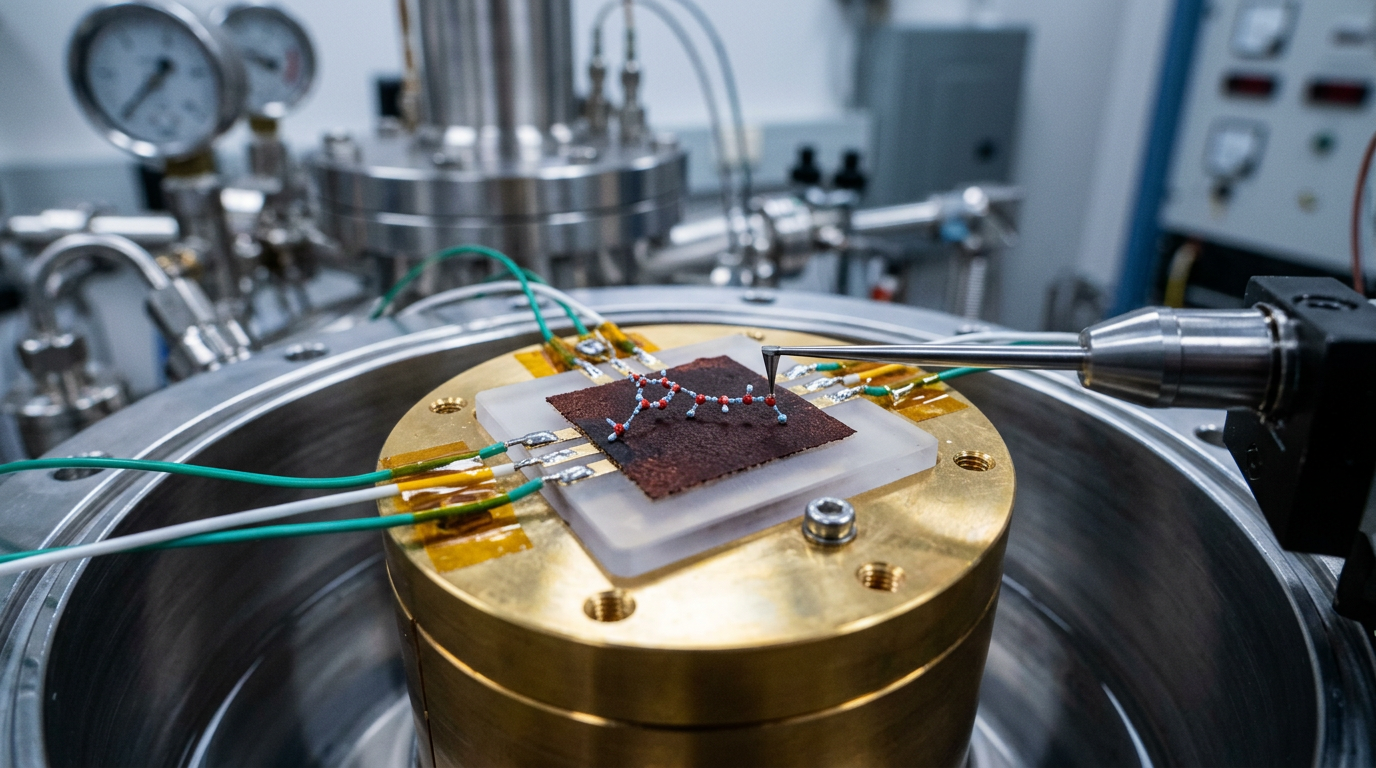
Recent discoveries in melanin's semiconductor properties have revealed an unexpected quantum mechanical dimension to this ubiquitous biological polymer. New evidence suggests that proton tunneling through melanin's hydrogen-bonded networks may underlie its remarkable electrical switching behavior and energy storage capabilities.
When John McGinness first demonstrated melanin's semiconductor switching behavior in 1974, he observed something peculiar: the polymer's electrical properties changed dramatically with hydration, exhibiting memory-like characteristics that defied simple electronic explanations. The switching wasn't just about electrons moving through the material—something more fundamental was happening at the quantum level.
Recent investigations into melanin's proton conductivity have revealed that this biological semiconductor operates through mechanisms far more sophisticated than initially understood. Unlike conventional semiconductors that rely purely on electron transport, melanin appears to harness proton tunneling—a quantum mechanical process where protons pass through energy barriers they classically shouldn't be able to cross.
The Architecture of Quantum Proton Transport
Melanin's unique molecular architecture creates ideal conditions for proton tunneling. The polymer consists of stacked aromatic units connected by extensive hydrogen bonding networks, forming what researchers describe as "proton highways" through the material. These networks, stabilized by the polymer's planar geometry and π-π stacking interactions, create quantum tunneling pathways with precisely tuned energy barriers.
Studies using deuterium isotope substitution have provided compelling evidence for quantum tunneling in melanin. When researchers replace hydrogen atoms with deuterium (which has twice the mass), the material's conductivity drops significantly—a classic signature of tunneling, since heavier particles tunnel less efficiently through quantum barriers. This kinetic isotope effect demonstrates that proton movement, not just electron transport, drives melanin's electrical behavior.
The implications extend beyond simple conductivity. Marcus theory, originally developed to describe electron transfer in biological systems, also applies to proton tunneling when reorganization energies of the surrounding molecular environment are considered. In melanin, the flexible hydrogen bonding network can reorganize to facilitate proton transfer, creating dynamic tunneling pathways that respond to the material's hydration state and local electric fields.
Energy Storage Through Quantum Coherence
Perhaps most intriguingly, melanin's proton tunneling networks may function as biological quantum batteries. The polymer's ability to store and release electrical energy appears linked to the formation of metastable proton configurations within its hydrogen-bonded lattice. These configurations, stabilized by quantum tunneling effects, can persist for extended periods before releasing their stored energy through controlled proton redistribution.
Research by Arturo Solís Herrera and colleagues has demonstrated that melanin can split water molecules and generate electrical current when exposed to light—a process they term melanin photosynthesis. The mechanism likely involves light-induced changes in the polymer's proton tunneling networks, creating charge separation that drives water splitting and subsequent energy storage in the form of organized proton gradients.
This quantum energy storage mechanism helps explain melanin's remarkable stability and its presence in extreme environments. The polymer's ability to harness quantum tunneling for energy management may represent an ancient biological solution to energy storage and transfer challenges, predating more familiar biological energy systems by hundreds of millions of years.
Biological Implications and Cellular Computing
The discovery of proton tunneling in melanin opens new perspectives on the polymer's biological functions. Beyond photoprotection, melanin may serve as a bioelectric processor, using quantum proton dynamics to process and store information at the cellular level. This aligns with emerging research on bioelectricity's role in morphogenesis, regeneration, and cellular decision-making.
Michael Levin's work on bioelectric signaling has shown that cells use membrane potential patterns to encode positional information and control gene expression. Melanin's quantum proton networks could provide a sophisticated substrate for such bioelectric computation, offering both memory storage and signal processing capabilities within individual cells.
The polymer's presence in critical neural structures like the substantia nigra takes on new significance in this context. Neuromelanin's proton tunneling networks might contribute to neural computation and memory formation, potentially explaining the cognitive changes observed when neuromelanin levels decline with age or disease.
Technological Frontiers and Future Directions
Understanding melanin's quantum proton dynamics could revolutionize bio-inspired technologies. The polymer's combination of energy storage, switching behavior, and environmental responsiveness—all driven by quantum tunneling—offers a blueprint for next-generation bioelectronic devices.
Current research focuses on characterizing the precise energy landscapes that govern proton tunneling in different melanin types. Advanced spectroscopic techniques, including electron paramagnetic resonance (EPR) and nuclear magnetic resonance (NMR), are revealing how the polymer's stable free radicals interact with its proton tunneling networks, creating coupled quantum systems of remarkable complexity.
The field now stands at a critical juncture. As quantum biology moves from exotic curiosity to established science, melanin's proton tunneling networks represent one of the most accessible and potentially transformative quantum biological systems for detailed study. The implications span from understanding fundamental life processes to developing revolutionary energy storage and computing technologies.
Key Takeaways
• Proton tunneling through melanin's hydrogen bonding networks provides a quantum mechanical basis for the polymer's unusual electrical switching and memory behaviors.
• Deuterium isotope effects confirm that quantum tunneling, not classical proton transport, drives melanin's conductivity changes with hydration.
• Melanin's proton tunneling networks may function as biological quantum batteries, storing energy in metastable proton configurations stabilized by quantum effects.
• The polymer's quantum proton dynamics could contribute to bioelectric computation and cellular information processing, extending melanin's role beyond simple photoprotection.
• Understanding melanin's proton tunneling mechanisms offers pathways to bio-inspired quantum technologies for energy storage and neuromorphic computing.
• Neuromelanin's presence in critical brain regions suggests quantum proton networks may play previously unrecognized roles in neural computation and memory formation.
References
McGinness, J., Corry, P., & Proctor, P. "Amorphous semiconductor switching in melanins." Science 183(4127), 853-855 (1974).
Mostert, A.B., et al. "Role of semiconductivity and ion transport in the electrical conduction of melanin." Proceedings of the National Academy of Sciences 109(23), 8943-8947 (2012).
Wünsche, J., et al. "Protonic and electronic transport in hydrated thin films of the pigment eumelanin." Chemistry of Materials 27(2), 436-442 (2015).
Solís-Herrera, A., Arias-Esparza, M.C., & Solís-Arias, R.I. "The unexpected capacity of melanin to dissociate the water molecule fills the gap between the life before and after ATP." Biomedical Research 21(2), 224-226 (2010).
Marcus, R.A. "Electron transfer reactions in chemistry: theory and experiment." Reviews of Modern Physics 65(3), 599-610 (1993).
Levin, M. "Bioelectric signaling: reprogrammable circuits underlying embryogenesis, regeneration, and cancer." Cell 184(8), 1971-1989 (2021).
Zecca, L., Youdim, M.B., Riederer, P., Connor, J.R., & Crichton, R.R. "Iron, brain ageing and neurodegenerative disorders." Nature Reviews Neuroscience 5(11), 863-873 (2004).