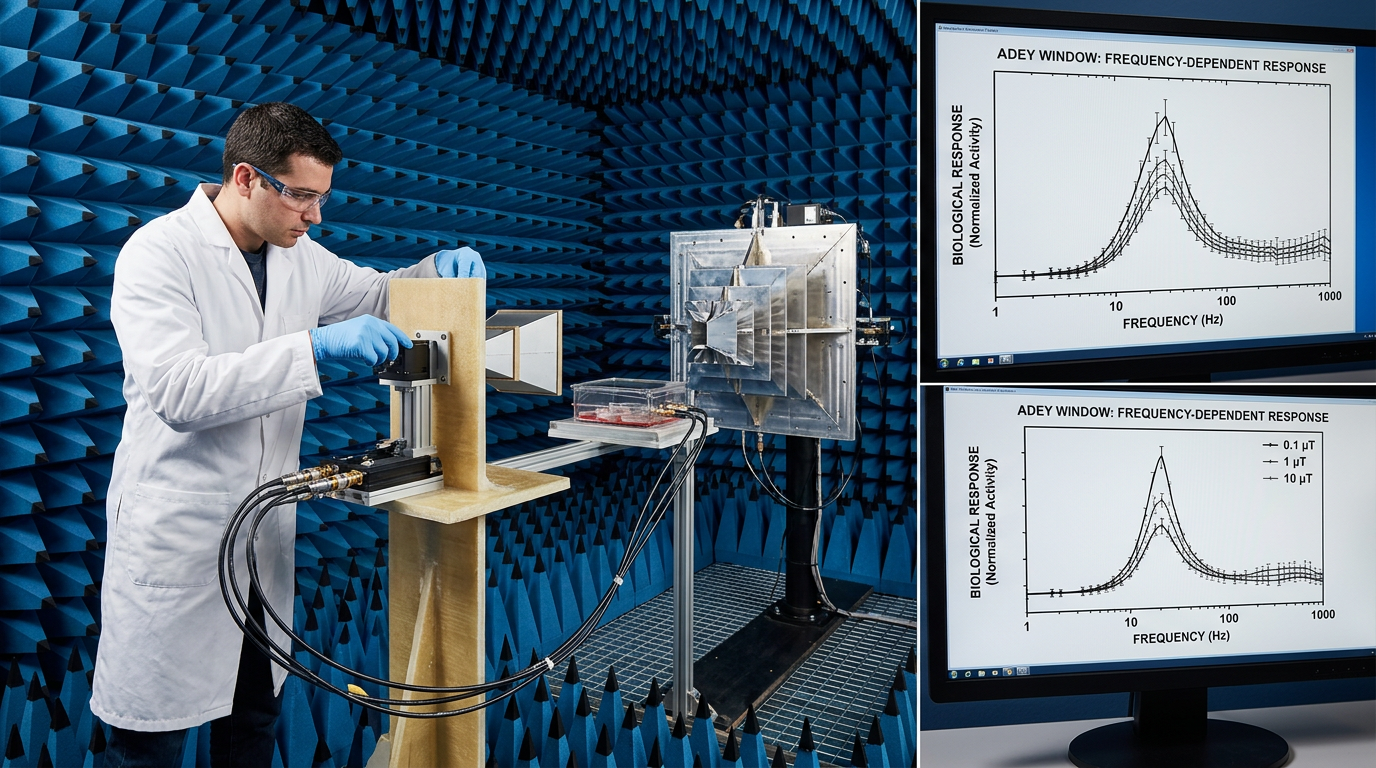
Decades of bioelectromagnetics research reveal that living systems operate as sophisticated frequency-selective receivers, responding to specific electromagnetic signatures with remarkable precision. This frequency-dependent behavior suggests that biological communication may rely on resonance phenomena far more complex than previously imagined. Understanding these electromagnetic windows could revolutionize our approach to cellular signaling, therapeutic interventions, and the biophysical basis of life itself.
When Ross Adey first observed that brain tissue responded to specific electromagnetic frequencies while remaining completely unaffected by others, he uncovered one of biology's most intriguing puzzles. Working at UCLA in the 1970s, Adey demonstrated that calcium ion efflux from brain tissue occurred only within narrow frequency windows—typically around 16 Hz—while frequencies just above or below produced no effect whatsoever. This phenomenon, now known as the Adey window, challenged the prevailing assumption that biological effects of electromagnetic fields should follow simple dose-response relationships.
The implications were profound: if living systems could discriminate between frequencies with such precision, they might be operating as biological receivers tuned to specific electromagnetic signatures.
The Architecture of Biological Frequency Response
The Adey window represents just one example of frequency-dependent biological responses that have been documented across multiple cellular systems. Research by Carl Blackman and colleagues at the EPA demonstrated that these windows exist not only for calcium signaling but for a range of cellular processes including enzyme activity, gene expression, and membrane permeability.
The characteristics of these responses defy conventional electromagnetic theory. At extremely low frequencies (ELF) in the range of 1-100 Hz, biological effects often occur at field strengths far below what classical physics would predict as biologically relevant. The power density of these fields—sometimes as low as microwatts per square centimeter—is orders of magnitude weaker than the thermal noise in biological systems, yet they produce measurable, reproducible effects.
This apparent violation of thermal noise limitations suggests that biological systems may employ coherent amplification mechanisms that can detect and respond to weak electromagnetic signals. Abraham Liboff's ion cyclotron resonance model proposed that ions in biological magnetic fields could exhibit resonant behavior at specific frequencies, providing a theoretical framework for understanding how weak ELF fields might influence cellular processes.
The frequency specificity extends beyond simple resonance. Studies have shown that biological responses often occur within multiple discrete frequency bands, creating what researchers term "frequency windows." These windows are not random but appear to follow mathematical relationships, suggesting an underlying organizational principle in biological electromagnetic sensitivity.
Calcium Signaling: The Cellular Telegraph System
Calcium ion signaling serves as the primary model system for understanding frequency-dependent biological responses. Calcium acts as a universal second messenger in cells, controlling everything from muscle contraction to gene transcription. The precision with which electromagnetic fields can modulate calcium dynamics reveals the sophistication of cellular electromagnetic sensing.
Research by Blackman's group demonstrated that calcium efflux from brain tissue occurs at specific combinations of static magnetic field strength and ELF frequency. The relationship follows predictable mathematical patterns: for a given static field, only certain frequencies will produce calcium release, and these frequencies shift predictably as the static field changes.
The mechanism appears to involve voltage-gated calcium channels (VGCCs) in cell membranes. These protein complexes, which normally respond to changes in membrane voltage, can be influenced by external electromagnetic fields through what researchers term "parametric resonance." The field doesn't directly open the channels but modulates their sensitivity to naturally occurring voltage fluctuations.
This electromagnetic modulation of calcium signaling has been observed across species and cell types, from chick embryo development to human lymphocyte activation. The consistency of these effects across biological systems suggests that electromagnetic sensitivity may be a fundamental property of cellular calcium homeostasis.
Resonance Phenomena in Living Systems
The concept of biological resonance extends beyond calcium signaling to encompass multiple levels of biological organization. At the molecular level, proteins and other biomolecules exhibit characteristic vibrational frequencies that can be influenced by external electromagnetic fields. These molecular vibrations, typically in the terahertz range, may provide a mechanism for frequency-specific biological responses.
Membrane systems appear particularly sensitive to electromagnetic resonance effects. Cell membranes, with their complex lipid-protein architecture, can support various modes of electromagnetic oscillation. Research has identified specific frequencies that enhance membrane permeability, alter ion channel function, or modify membrane-bound enzyme activity.
The dielectric properties of biological tissues play a crucial role in determining frequency-specific responses. Different tissues exhibit distinct dielectric constants and conductivities, creating frequency-dependent absorption and field distribution patterns. This tissue-specific electromagnetic behavior may explain why certain frequencies affect particular organs or cell types preferentially.
Perhaps most intriguingly, some researchers have proposed that biological systems may utilize coherent electromagnetic oscillations for intercellular communication. Fritz-Albert Popp's work on biophoton emission suggested that cells might communicate through ultra-weak light signals, while more recent research has explored whether cells could use electromagnetic fields for coordinated behavior during development and healing.
Implications for Melanin and Cellular Communication
The frequency-dependent nature of biological electromagnetic responses takes on new significance when considered alongside melanin's unique electrical properties. As a bioelectronic material with semiconductor characteristics and broadband electromagnetic absorption, melanin is positioned to play a central role in cellular frequency discrimination.
Melanin's stable free radical population, detectable through electron paramagnetic resonance (EPR) spectroscopy, could serve as a frequency-sensitive detection system. The radical states in melanin can be modulated by electromagnetic fields, potentially allowing melanin-containing cells to respond selectively to specific frequencies while filtering out others.
The hydration-dependent conductivity of melanin adds another layer of frequency selectivity. As melanin's electrical properties change with hydration state, its frequency response characteristics would also shift, providing a dynamic mechanism for tuning cellular electromagnetic sensitivity based on physiological conditions.
This suggests that melanin might function as a biological frequency filter, allowing cells to discriminate between different electromagnetic signals in their environment. Such a system could enable sophisticated forms of cellular communication based on frequency-coded information rather than simple chemical signaling.
Key Takeaways
• Biological systems demonstrate frequency-specific responses to electromagnetic fields through phenomena like the Adey window, where effects occur only within narrow frequency bands despite weak field strengths.
• Calcium signaling pathways exhibit remarkable electromagnetic sensitivity, with calcium efflux occurring at specific frequency-magnetic field combinations that follow predictable mathematical relationships.
• The frequency selectivity of biological responses suggests that living systems may operate as sophisticated electromagnetic receivers capable of discriminating between different frequency signatures.
• Resonance phenomena at multiple biological scales—from molecular vibrations to membrane oscillations—provide potential mechanisms for frequency-dependent cellular responses.
• Melanin's unique bioelectronic properties, including stable free radicals and hydration-dependent conductivity, position it as a potential biological frequency filter for electromagnetic cellular communication.
• Understanding frequency-dependent biological responses could revolutionize therapeutic approaches and reveal new mechanisms of intercellular communication based on electromagnetic rather than purely chemical signaling.
References
Adey, W.R. "Tissue interactions with nonionizing electromagnetic fields." Physiological Reviews 61(2), 435-514 (1981).
Blackman, C.F., Benane, S.G., Elder, J.A., House, D.E., Lampe, J.A., & Faulk, J.M. "Induction of calcium-ion efflux from brain tissue by radiofrequency radiation." Radio Science 14(6S), 93-98 (1979).
Liboff, A.R. "Cyclotron resonance in membrane transport." Interactions Between Electromagnetic Fields and Cells, 281-296 (1985).
Blackman, C.F., Blanchard, J.P., Benane, S.G., & House, D.E. "Empirical test of an ion parametric resonance model for magnetic field interactions with PC-12 cells." Bioelectromagnetics 15(3), 239-260 (1994).
Pilla, A.A. "Mechanisms and therapeutic applications of time-varying and static magnetic fields." Handbook of Biological Effects of Electromagnetic Fields, 351-411 (2007).
Popp, F.A., Nagl, W., Li, K.H., Scholz, W., Weingärtner, O., & Wolf, R. "Biophoton emission: New evidence for coherence and DNA as source." Cell Biophysics 6(1), 33-52 (1984).
Barnes, F.S. & Greenebaum, B. "Some effects of weak magnetic fields on biological systems." IEEE Power Engineering Review 22(2), 53-55 (2002).
Binhi, V.N. & Savin, A.V. "Effects of weak magnetic fields on biological systems: Physical aspects." Physics-Uspekhi 46(3), 259-291 (2003).