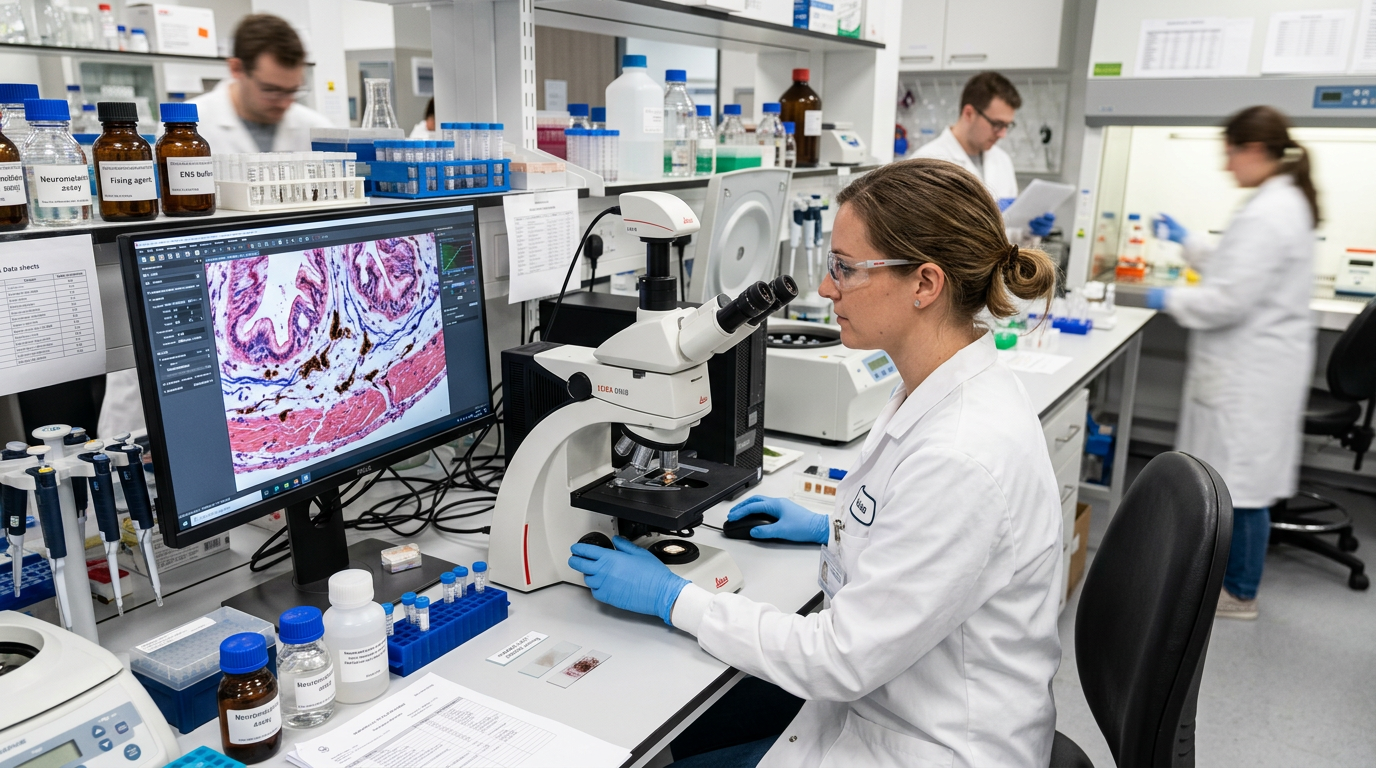
The enteric nervous system harbors an overlooked population of melanin-producing cells that may fundamentally alter our understanding of gut-brain communication. Recent discoveries reveal that neuromelanin biosynthesis shares critical pathways with neurotransmitter production, creating a biochemical bridge between microbial metabolism and neural signaling. This emerging picture suggests melanin functions not merely as a protective pigment, but as an active participant in the body's most sophisticated communication networks.
The human gut contains approximately 500 million neurons—more than the spinal cord—yet until recently, researchers largely ignored the presence of melanin-producing cells scattered throughout this "second brain." These cells, found in both the enteric nervous system and specialized gut tissues, synthesize neuromelanin, a complex polymer that differs significantly from the eumelanin in skin. Unlike its dermal counterpart, neuromelanin incorporates dopamine, norepinephrine, and other catecholamines directly into its structure, creating what biochemists describe as a "neurotransmitter archive."
This discovery becomes particularly intriguing when considered alongside the gut microbiome's profound influence on melanin precursor availability. The amino acid tryptophan—essential for both serotonin and melanin synthesis—exists at the mercy of bacterial metabolism. Certain gut bacteria can either enhance tryptophan availability or shunt it toward alternative pathways, potentially determining whether this precious molecular currency flows toward neurotransmitter production or melanin synthesis.
The Serotonin-Melanin Convergence
The biochemical relationship between serotonin and melanin production represents one of biology's most elegant examples of metabolic efficiency. Both pathways begin with tryptophan, but their downstream fates depend on enzymatic decisions made within individual cells. Tryptophan hydroxylase (TPH) converts tryptophan to 5-hydroxytryptophan, the immediate precursor to serotonin. However, under specific conditions, this same tryptophan can be diverted toward melanin synthesis through the enzyme tyrosinase and related oxidases.
Research by Schallreuter and colleagues has demonstrated that melanocytes possess the enzymatic machinery for both pathways, suggesting these cells function as metabolic switches capable of responding to local biochemical environments. In the gut, where 90% of the body's serotonin is produced, this dual capacity takes on particular significance. Enterochromaffin cells—the gut's primary serotonin producers—also express melanogenic enzymes, though their melanin production remains poorly characterized.
The implications extend beyond simple biochemistry. Serotonin serves as a critical signaling molecule between gut bacteria and host neurons, influencing everything from mood to intestinal motility. If melanin-producing cells in the gut can modulate this signaling—either by competing for tryptophan or by storing neurotransmitter-derived molecules within melanin polymers—they represent an previously unrecognized regulatory mechanism in gut-brain communication.
Microbial Architects of Melanin Metabolism
The gut microbiome's influence on melanin precursor availability operates through multiple sophisticated mechanisms. Certain bacterial strains, particularly Lactobacillus species, produce enzymes that enhance tryptophan bioavailability by breaking down dietary proteins and releasing bound amino acids. Conversely, bacteria like Clostridium sporogenes can convert tryptophan into indole and other metabolites that may interfere with melanin synthesis.
More intriguingly, some gut bacteria produce their own melanin-like compounds. Prevotella melaninogenica, a common oral and gut bacterium, synthesizes dark pigments through pathways that parallel human melanogenesis. These bacterial pigments, while structurally distinct from human neuromelanin, share key properties including metal chelation capacity and antioxidant activity.
Recent metabolomic studies have revealed that individuals with different microbiome compositions show varying levels of melanin precursors in their blood and urine. People with higher abundances of tryptophan-metabolizing bacteria tend to have altered ratios of serotonin metabolites, suggesting their gut bacteria are actively competing with host cells for these precious molecular building blocks. This bacterial influence may partially explain why gut dysbiosis correlates with both mood disorders and certain neurodegenerative conditions characterized by neuromelanin loss.
Neuromelanin as a Neural Memory Bank
Perhaps the most fascinating aspect of gut neuromelanin lies in its potential function as a biochemical memory system. Unlike other biological polymers that undergo regular turnover, neuromelanin accumulates throughout life, incorporating environmental chemicals, neurotransmitters, and metal ions into its growing structure. In the brain's substantia nigra, neuromelanin serves as a historical record of dopaminergic activity—its concentration directly correlates with lifetime dopamine production.
The gut's neuromelanin may serve a similar archival function, but with access to a far more diverse chemical environment. The intestinal tract encounters thousands of dietary compounds, bacterial metabolites, and pharmaceutical agents daily. If gut melanocytes incorporate these molecules into growing neuromelanin polymers, they create a unique biochemical library of the body's chemical exposure history.
This concept gains support from studies showing that neuromelanin can bind and slowly release incorporated molecules over extended periods. Researchers have detected decades-old pharmaceutical compounds within brain neuromelanin samples, suggesting these polymers function as long-term molecular reservoirs. In the gut, where chemical diversity far exceeds that of brain tissue, neuromelanin might serve as a sophisticated buffering system, moderating the impact of dietary and microbial chemical fluctuations on neural signaling.
Bioelectric Implications and Future Directions
The semiconductor properties of melanin add another layer of complexity to gut-brain communication. Neuromelanin, like other melanin forms, exhibits proton conductivity and can facilitate electron transfer reactions. In the electrically active environment of the enteric nervous system, these properties might enable neuromelanin to participate directly in bioelectric signaling.
The gut maintains complex bioelectric patterns that coordinate peristalsis, regulate barrier function, and communicate with the central nervous system. If neuromelanin-containing cells contribute to these bioelectric networks—either through their semiconductor properties or by modulating local ion concentrations—they represent an entirely new class of bioelectric regulators.
This possibility becomes particularly relevant when considering the gut's role in systemic inflammation and immune function. Neuromelanin's metal-chelating properties and antioxidant capacity might help maintain bioelectric stability during inflammatory episodes, when reactive oxygen species and altered ion concentrations typically disrupt normal electrical signaling.
Key Takeaways
• Neuromelanin synthesis in gut tissues shares biochemical pathways with serotonin production, creating competition for tryptophan resources that may influence both neurotransmitter availability and pigment formation.
• Gut microbiome composition directly affects melanin precursor availability through bacterial metabolism of tryptophan and other aromatic amino acids, suggesting microbes actively participate in host melanin regulation.
• Neuromelanin functions as a biochemical archive, accumulating neurotransmitters and environmental compounds throughout life, potentially serving as a long-term buffering system for chemical fluctuations in the gut environment.
• The semiconductor properties of neuromelanin may enable direct participation in the gut's bioelectric signaling networks, representing a previously unrecognized mechanism of gut-brain communication.
• Bacterial production of melanin-like compounds creates a parallel pigment system that may interact with host melanogenesis through shared metal-chelating and antioxidant functions.
• Understanding gut-melanin interactions could provide new therapeutic targets for conditions involving both gut dysbiosis and neuromelanin pathology, including Parkinson's disease and inflammatory bowel disorders.
References
McGinness, J., Corry, P., & Proctor, P. "Amorphous semiconductor switching in melanins." Science 183(4127), 853-855 (1974).
Schallreuter, K.U., et al. "Regulation of melanogenesis—controversies and new concepts." Experimental Dermatology 17(5), 395-404 (2008).
Yano, J.M., et al. "Indigenous bacteria from the gut microbiota regulate host serotonin biosynthesis." Cell 161(2), 264-276 (2015).
Zecca, L., et al. "Neuromelanin can protect against iron-mediated oxidative damage in system modeling iron overload of brain aging and Parkinson's disease." Journal of Neurochemistry 106(4), 1866-1875 (2008).
Sulzer, D., et al. "Neuromelanin biosynthesis is driven by excess cytosolic catecholamines not accumulated by synaptic vesicles." Proceedings of the National Academy of Sciences 97(22), 11869-11874 (2000).
Clarke, G., et al. "The microbiome-gut-brain axis during early life regulates the hippocampal serotonergic system in a sex-dependent manner." Molecular Psychiatry 18(6), 666-673 (2013).
Wakamatsu, K., & Ito, S. "Advanced chemical methods in melanin determination." Pigment Cell Research 15(3), 174-183 (2002).