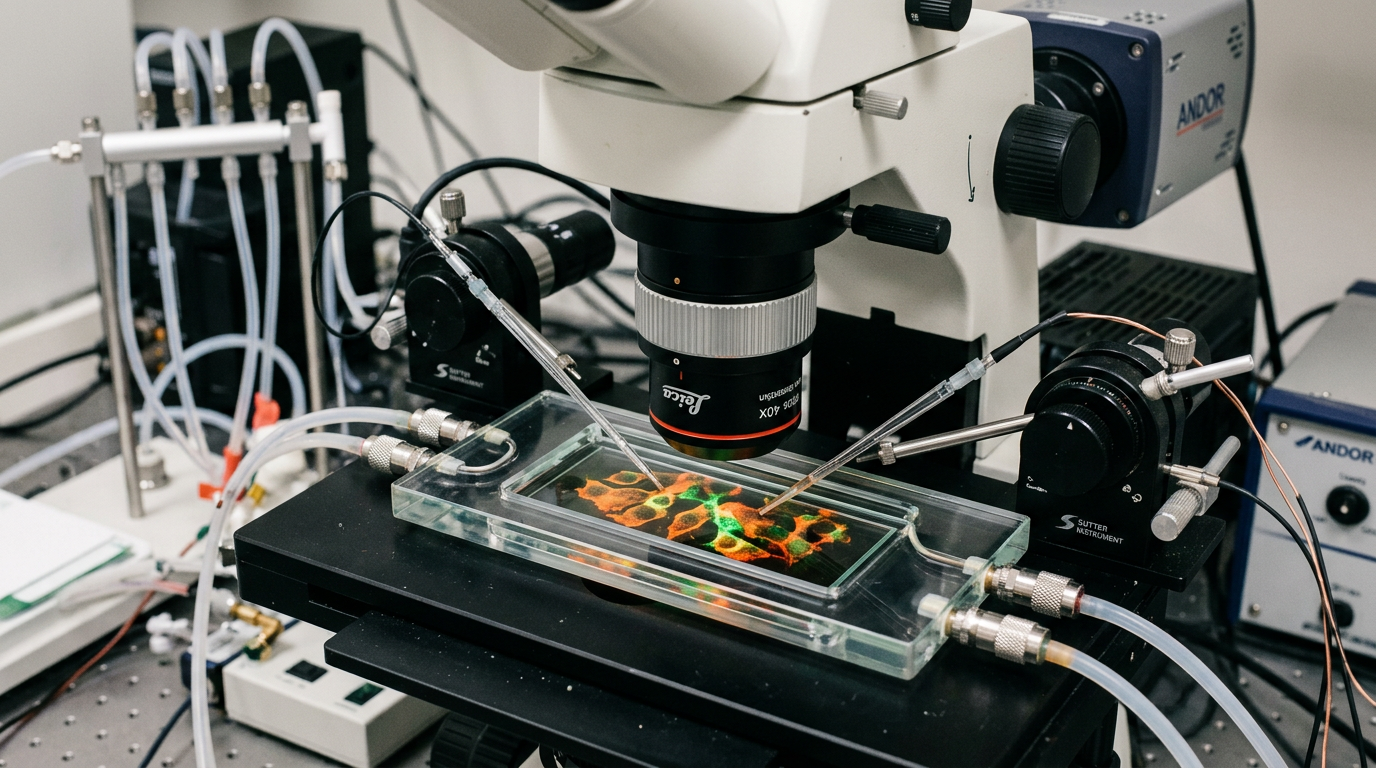
Emerging evidence suggests melanin doesn't just absorb light—it may actively regulate the electrical state of cells. This intersection of pigment biology and bioelectricity reveals new mechanisms by which melanin influences cellular behavior and tissue organization.
The electrical potential across a cell's membrane—its membrane voltage or Vmem—has emerged as a master regulator of cellular identity. While neuroscientists have long studied electrical signaling in nerve cells, Michael Levin's lab at Tufts University has demonstrated that virtually all cells use bioelectric signals to control growth, differentiation, and even cancer suppression. Healthy, differentiated cells typically maintain membrane potentials around -50 to -70 millivolts, while proliferative and potentially tumorigenic cells show characteristic depolarization to voltages above -20mV.
But here's what makes this particularly intriguing for melanin research: melanin's unique semiconductor properties and its intimate association with cellular membranes suggest it may serve as more than a passive photoprotective shield. Recent investigations into melanin's electrical behavior reveal that this ancient pigment might actively participate in the bioelectric networks that govern cellular fate.
Melanin's Electrical Identity
Melanin exhibits semiconductor behavior with a bandgap of approximately 1.85 electron volts, placing it in the range of organic semiconductors. John McGinness first demonstrated in the 1970s that melanin films could function as electrical switches, with conductivity dramatically increasing upon hydration. This hydration-dependent conductivity occurs because water molecules facilitate proton transport through melanin's complex polymer structure.
The pigment also harbors stable free radicals detectable by electron paramagnetic resonance (EPR) spectroscopy—a property that distinguishes melanin from most biological molecules. These unpaired electrons, rather than being signs of damage, appear to be integral to melanin's function. The radical concentration correlates with melanin's electrical activity, suggesting these electron spins participate in charge transport mechanisms.
When melanin granules (melanosomes) are positioned near cellular membranes—as they are in melanocytes, retinal pigment epithelium, and neurons containing neuromelanin—they create microenvironments where electrical properties could influence membrane behavior. The proximity isn't coincidental; melanosomes often cluster near the cell periphery where they could interact with membrane-spanning ion channels and transporters that establish Vmem.
Bioelectric Control of Cellular Fate
Michael Levin's research has revealed that membrane voltage serves as a bioelectric code determining cellular behavior. Cells communicate through bioelectric networks created by gap junctions and ion channel activity. When these networks maintain appropriate voltage gradients, tissues develop normally and resist cancer. However, disruption of bioelectric patterns—particularly depolarization below the critical -20mV threshold—correlates with loss of growth control and malignant transformation.
This bioelectric framework explains why certain regions of the body show different cancer susceptibilities. The heart, with its robust electrical activity, rarely develops primary tumors. Conversely, tissues with disrupted bioelectric patterns become vulnerable to oncogenic transformation, even in the presence of cancer-causing mutations.
Levin's lab has demonstrated that artificially hyperpolarizing cells (making them more negative) can normalize the behavior of cancer cells, while depolarization can induce tumor-like growth in normal tissues. The voltage threshold around -20mV appears to represent a critical decision point where cells choose between differentiated stability and proliferative activity.
The Melanin-Membrane Interface
Several lines of evidence suggest melanin may influence membrane voltage regulation. First, melanin's proton conductivity could affect local pH gradients near membranes, indirectly influencing voltage-sensitive ion channels. Proton pumps and pH-sensitive channels are key regulators of membrane potential, and melanin's ability to transport protons positions it to modulate these systems.
Second, melanin's interaction with metal ions—particularly calcium and iron—could influence membrane-associated enzymes and channels. Neuromelanin in the substantia nigra binds iron and other metals, potentially affecting the activity of metal-dependent membrane proteins. Calcium signaling, intimately connected to membrane voltage through calcium-activated potassium channels, could be modulated by melanin's metal-binding properties.
Third, melanin's response to electromagnetic radiation extends beyond visible light into radio frequencies and even static electric fields. This broad-spectrum sensitivity suggests melanin could serve as a biological antenna, transducing environmental electrical signals into biochemical responses that affect membrane voltage.
Research on bioelectric pattern formation shows that tissues maintain specific voltage landscapes that guide development and regeneration. Melanin distribution often correlates with these bioelectric patterns—consider how pigmentation patterns in developing embryos follow electrical field gradients, or how melanin accumulation in aging neurons coincides with altered electrical activity.
Implications for Health and Disease
The melanin-bioelectric connection offers new perspectives on several medical puzzles. Vitiligo, characterized by melanocyte loss, might involve not just immune destruction but also bioelectric disruption that prevents melanocyte survival. The observation that vitiligo patches sometimes show altered nerve function supports this bioelectric component.
Melanoma's aggressive behavior could partly reflect disrupted bioelectric control. If melanin normally helps maintain proper membrane voltage in melanocytes, its dysregulation in melanoma might contribute to the bioelectric depolarization that characterizes cancer cells. This would explain why melanoma often shows such rapid progression compared to other skin cancers.
Neurodegeneration involving neuromelanin—such as in Parkinson's disease—might also have bioelectric components. The loss of neuromelanin-containing neurons in the substantia nigra could disrupt bioelectric patterns necessary for proper neural network function, contributing to motor control problems beyond simple neurotransmitter deficiency.
Age-related changes in melanin distribution and properties might influence tissue bioelectricity, potentially contributing to increased cancer risk and decreased regenerative capacity in older adults. The gradual accumulation of neuromelanin with age, rather than being merely a sign of cellular wear, might represent an adaptive response to maintain bioelectric stability in aging neurons.
Key Takeaways
• Melanin exhibits semiconductor properties and proton conductivity that could influence cellular membrane voltage, connecting pigment biology to bioelectric signaling networks.
• Michael Levin's research demonstrates that membrane voltage below -20mV correlates with proliferative and potentially cancerous cellular states, while healthy differentiated cells maintain more negative potentials.
• Melanin's positioning near cellular membranes and its interactions with ions and electromagnetic fields suggest it may actively participate in bioelectric pattern regulation rather than serving purely as photoprotection.
• The melanin-bioelectric axis offers new explanations for diseases like vitiligo, melanoma, and neurodegeneration that involve both pigment dysregulation and altered cellular electrical activity.
• Understanding how melanin influences membrane voltage could reveal new therapeutic targets for cancer prevention, regenerative medicine, and neurodegenerative disease treatment.
• This intersection of pigment biology and bioelectricity represents an underexplored frontier that could transform our understanding of how cells maintain identity and resist malignant transformation.
References
Levin, M. "Bioelectric signaling: Reprogrammable circuits underlying embryogenesis, regeneration, and cancer." Cell 184(8), 1971-1989 (2021). DOI: 10.1016/j.cell.2021.02.034
McGinness, J., Corry, P., & Proctor, P. "Amorphous semiconductor switching in melanins." Science 183(4127), 853-855 (1974). DOI: 10.1126/science.183.4127.853
Chernoff, E.A.G., Sato, K., Saito, A., et al. "A bioelectric model of carcinogenesis, including initiation by chronic inflammation." Theoretical Biology and Medical Modelling 15, 17 (2018). DOI: 10.1186/s12976-018-0089-x
Meredith, P. & Sarna, T. "The physical and chemical properties of eumelanin." Pigment Cell Research 19(6), 572-594 (2006). DOI: 10.1111/j.1600-0749.2006.00345.x
Yang, M. & Brackenbury, W.J. "Membrane potential and cancer progression." Frontiers in Physiology 4, 185 (2013). DOI: 10.3389/fphys.2013.00185
Bustamante, J., Bredeston, L., Malanga, G., & Mordoh, J. "Role of melanin as a scavenger of active oxygen species." Pigment Cell Research 6(5), 348-353 (1993). DOI: 10.1111/j.1600-0749.1993.tb00612.x