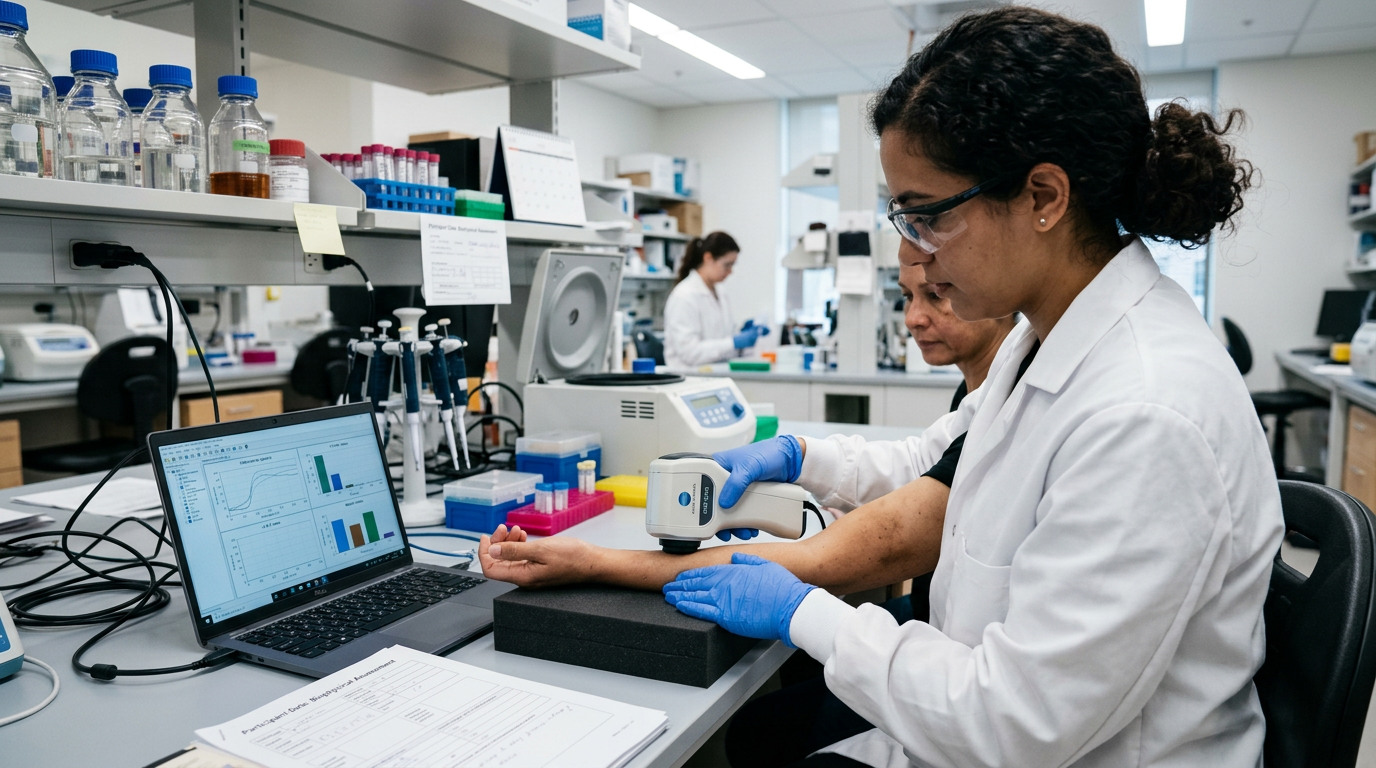
The Fitzpatrick scale's six categories tell us how skin burns, but they reveal nothing about melanin's semiconductor properties, hydration-dependent conductivity, or quantum mechanical behavior. As research unveils melanin's role as a biological photoelectric material, clinical science needs assessment tools that match the sophistication of the molecule itself.
When Thomas Fitzpatrick developed his skin classification system in 1975, he had a specific clinical goal: predicting how different individuals would respond to UV phototherapy for psoriasis. His six-category scale, based on burning and tanning responses, served that purpose well. Nearly five decades later, however, we're still using this narrow framework to categorize one of biology's most sophisticated materials.
The problem isn't just academic. As personalized medicine advances and our understanding of melanin's biophysical properties deepens, the Fitzpatrick scale's limitations are becoming a barrier to both research and clinical care. We need a classification system that reflects what we now know: melanin isn't just a passive UV filter, but an active bioelectric material with semiconductor properties, proton conductivity, and complex interactions with electromagnetic radiation across the entire spectrum.
The Biophysical Reality Behind Skin Color
Modern spectrophotometric analysis reveals that what we perceive as skin color represents a complex interplay of multiple chromophores, with melanin being just one component. Eumelanin, the brown-black polymer concentrated in skin, hair, and eyes, exhibits a bandgap of approximately 1.85 eV—placing it squarely in the semiconductor range. Pheomelanin, the red-yellow variant, has entirely different optical and electrical properties, including photosensitizing behavior that can generate reactive oxygen species under UV exposure.
Research by Meredith and Sarna has shown that the ratio of eumelanin to pheomelanin varies dramatically even within the same Fitzpatrick category. Two individuals classified as "Type III" might have fundamentally different melanin compositions: one dominated by photoprotective eumelanin, another with significant pheomelanin content that actually increases photodamage risk under certain conditions. This isn't a minor technical detail—it's a fundamental mischaracterization that affects everything from sunscreen recommendations to photodynamic therapy protocols.
The electrical properties add another layer of complexity entirely missing from visual classification. Melanin's conductivity increases by several orders of magnitude when hydrated, transforming from an insulator to a semiconductor. This hydration-dependent behavior, documented extensively by Mostert and colleagues, means that melanin's bioelectric function varies with skin moisture, environmental humidity, and even circadian rhythms that affect tissue hydration.
Spectroscopic Windows Into Melanin Function
Advanced spectrophotometric techniques now allow us to peer beyond surface color into melanin's functional properties. Diffuse reflectance spectroscopy can distinguish eumelanin from pheomelanin based on their distinct absorption profiles across UV, visible, and near-infrared wavelengths. Eumelanin shows characteristic broadband absorption with a monotonic decrease from UV to infrared, while pheomelanin exhibits specific absorption peaks that reveal its benzothiazine structure.
Electron paramagnetic resonance (EPR) spectroscopy detects the stable free radicals inherent to melanin's structure—a property that makes it unique among biological polymers. The EPR signal intensity correlates with melanin concentration and can distinguish between different melanin types based on their radical signatures. This technique has revealed that melanin content varies by factors of 10-20 even among individuals with similar visual appearance.
Perhaps most significantly, impedance spectroscopy can measure melanin's electrical properties in vivo. Studies by Felix and colleagues have shown that skin impedance patterns correlate with melanin content and type, but these electrical signatures don't map cleanly onto Fitzpatrick categories. Some Type II individuals show impedance profiles more similar to Type V, while some Type IV individuals cluster with Type II in their electrical behavior.
Clinical Implications of Biophysical Classification
The medical consequences of melanin misclassification extend far beyond cosmetic concerns. In photodynamic therapy for skin cancers, treatment protocols are typically adjusted based on Fitzpatrick type, but melanin's actual photophysical properties—not its visual appearance—determine how tissues respond to photosensitizers and therapeutic light. Patients with high pheomelanin content may require different protocols regardless of their Fitzpatrick classification, as pheomelanin can interfere with photosensitizer activation while simultaneously generating harmful photoproducts.
Laser dermatology faces similar challenges. Laser parameters are routinely adjusted for "skin type," but melanin's absorption coefficient at specific laser wavelengths depends on its molecular composition, not its visual darkness. A spectrophotometrically-guided approach could optimize treatment parameters based on actual chromophore content, potentially improving outcomes while reducing adverse effects.
The emerging field of bioelectric medicine presents perhaps the most compelling case for biophysical classification. If melanin functions as a biological semiconductor involved in cellular signaling—as suggested by its electrical properties and ubiquitous presence in neural tissues—then understanding an individual's melanin profile becomes relevant to neurological health, wound healing, and even responses to bioelectric therapies.
Toward Personalized Photomedicine
A melanin-based classification system would incorporate multiple biophysical parameters: eumelanin/pheomelanin ratio, total melanin density, electrical conductivity profiles, and spectral absorption characteristics. Such a system could use portable spectrophotometric devices to generate individual "melanin profiles" that inform personalized treatment decisions.
This approach aligns with broader trends in precision medicine, where genetic, molecular, and physiological profiling guides therapeutic choices. Just as we've moved beyond simple visual assessment in other areas of medicine—using molecular markers rather than tumor appearance to guide cancer treatment, for example—dermatology and photomedicine could benefit from moving beyond visual skin typing.
The technology exists today. Handheld spectrophotometers can measure melanin content and type in seconds. Impedance measurement devices can assess electrical properties non-invasively. Machine learning algorithms can integrate these multiple parameters into clinically useful classifications. What's needed is the clinical validation and standardization that would make such systems practical for widespread use.
Key Takeaways
• The Fitzpatrick scale, designed for UV sensitivity assessment, fails to capture melanin's biophysical diversity, including the critical distinction between photoprotective eumelanin and photosensitizing pheomelanin.
• Spectrophotometric analysis reveals that individuals with similar visual appearance can have dramatically different melanin compositions, with eumelanin/pheomelanin ratios varying by orders of magnitude within the same Fitzpatrick category.
• Melanin's semiconductor properties and hydration-dependent conductivity represent functional characteristics entirely absent from visual classification systems, yet potentially crucial for bioelectric medicine applications.
• Modern photodynamic therapy and laser dermatology protocols based on Fitzpatrick typing may be suboptimal because they don't account for actual chromophore properties that determine light-tissue interactions.
• Portable spectrophotometric and impedance measurement technologies could enable personalized melanin profiling, supporting precision approaches to photomedicine and dermatological care.
• A biophysical melanin classification system would better serve both research and clinical applications as we increasingly recognize melanin's roles beyond simple photoprotection.
References
Meredith, P. & Sarna, T. "The physical and chemical properties of eumelanin." Pigment Cell Research 19(6), 572-594 (2006).
Mostert, A.B. et al. "Role of semiconductivity and ion transport in the electrical conduction of melanin." Proceedings of the National Academy of Sciences 109(23), 8943-8947 (2012).
Felix, C. et al. "Electrical impedance of melanin samples at different hydration levels." Journal of Physical Chemistry B 107(5), 1230-1234 (2003).
Fitzpatrick, T.B. "The validity and practicality of sun-reactive skin types I through VI." Archives of Dermatology 124(6), 869-871 (1988).
Sarna, T. & Swartz, H.M. "The physical properties of melanins." The Pigmentary System (Oxford University Press, 1998), 333-357.
McGinness, J. et al. "Amorphous semiconductor switching in melanins." Science 183(4127), 853-855 (1974).
Kollias, N. & Baqer, A. "Spectroscopic characteristics of human melanin in vivo." Journal of Investigative Dermatology 85(1), 38-42 (1985).