The dark pigment in our skin, eyes, and brain doesn't just absorb light—it transforms virtually every form of energy it encounters into usable biological currency. Recent research reveals melanin as one of biology's most sophisticated energy transduction systems, operating at efficiencies that rival engineered materials.
In the depths of the Chernobyl nuclear reactor, where radiation levels would kill most life forms within hours, a peculiar discovery emerged in the late 1990s. Researchers found thick mats of dark, melanin-rich fungi thriving on the reactor walls, apparently feeding on the intense gamma radiation. This wasn't merely survival—these organisms were using melanin to harvest energy from one of the most hostile environments on Earth, converting deadly radiation into the chemical energy needed for growth.
This extraordinary finding hints at melanin's true nature: not simply a passive sunscreen, but an active energy conversion system that may represent one of evolution's earliest and most versatile solutions to the fundamental challenge of harvesting energy from the environment. While photosynthesis captures headlines as nature's premier energy conversion process, melanin operates across a far broader spectrum of energy sources, transforming light, heat, and even mechanical forces into biologically useful forms.
The Physics of Melanin's Energy Appetite
Melanin exists in several forms throughout biology, but eumelanin—the brown-black pigment dominant in human skin and hair—demonstrates the most remarkable energy conversion properties. Its molecular structure consists of polymerized units derived from the amino acid tyrosine, creating a complex network of conjugated aromatic rings that behave like a biological semiconductor.
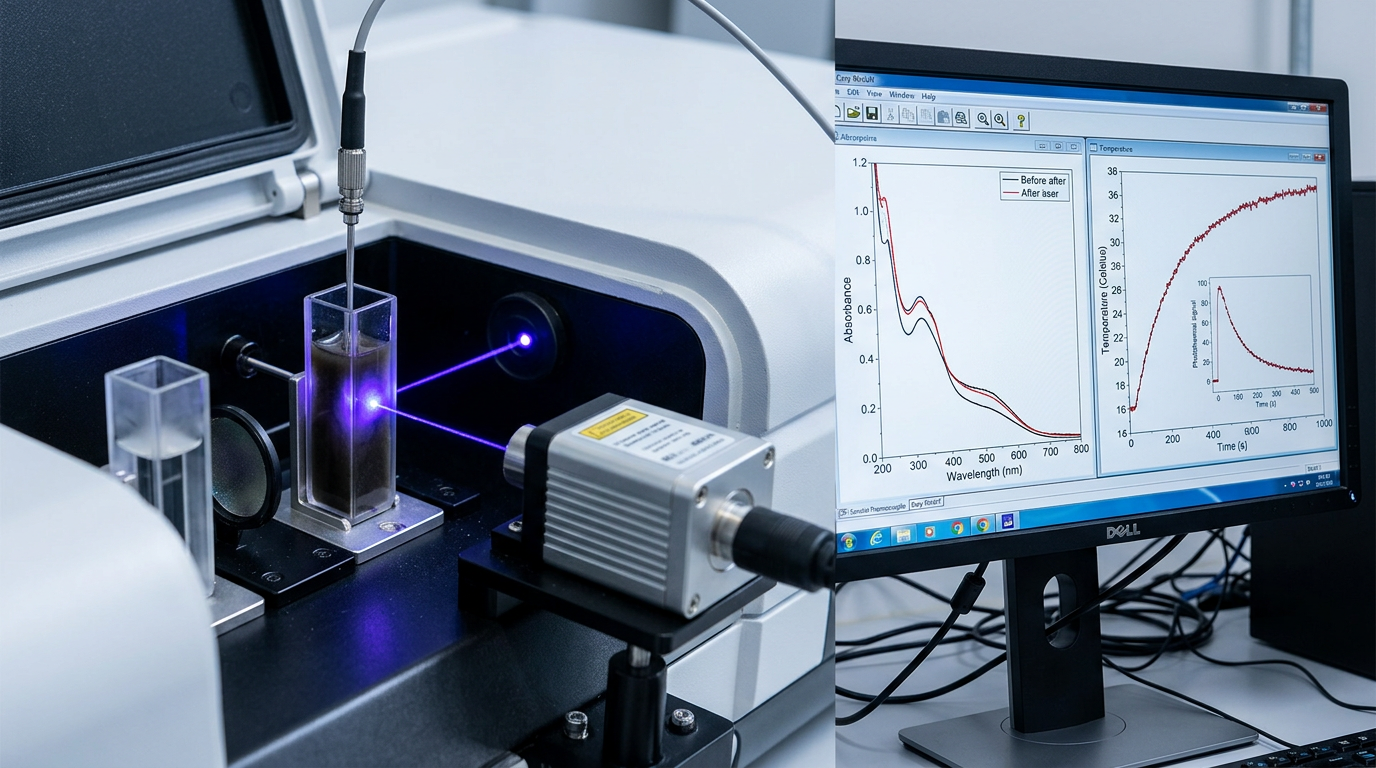
The key to melanin's energy-harvesting prowess lies in its extraordinary absorption characteristics. Unlike most biological molecules that absorb light at specific wavelengths, melanin displays broadband absorption across the entire electromagnetic spectrum, from ultraviolet through visible light and into the infrared. This monotonic absorption profile—where absorption decreases gradually with increasing wavelength—allows melanin to capture energy from virtually any photon that strikes it.
Research by Meredith and Sarna published in Pigment Cell Research demonstrated that melanin can absorb over 99% of incident UV radiation. But absorption is only the first step. The critical question is what happens to that captured energy. Studies using time-resolved spectroscopy reveal that melanin converts absorbed photons into heat through a process called non-radiative relaxation with remarkable efficiency—typically greater than 99.9% of absorbed energy becomes thermal energy within picoseconds.
This photothermal conversion serves an obvious protective function, safely dissipating potentially DNA-damaging UV energy as harmless heat. But recent investigations suggest melanin's energy transduction capabilities extend far beyond photoprotection.
Beyond Light: Mechanical and Thermal Energy Harvesting
The discovery that melanin might function as a piezoelectric material—converting mechanical stress into electrical energy—emerged from biomaterials research led by investigators studying melanin's electronic properties. When mechanical pressure is applied to hydrated melanin films, researchers have measured the generation of electrical currents, suggesting the pigment can transduce mechanical energy into bioelectric signals.
This piezoelectric-like behavior appears linked to melanin's hydration state and its population of stable free radicals. Melanin contains approximately 10^17 unpaired electrons per gram—stable free radicals that can be detected using electron paramagnetic resonance (EPR) spectroscopy. These radicals, rather than being harmful oxidative species, appear to function as charge carriers that enable melanin's electronic properties.
The implications become intriguing when considering melanin's distribution in mechanically active tissues. Neuromelanin accumulates in the substantia nigra of the brain, a region crucial for motor control. Could the mechanical forces generated by neural activity—the physical compression and expansion of brain tissue during neural firing—contribute to energy generation through melanin's piezoelectric properties?
Similarly, melanin's presence in the inner ear, particularly in the stria vascularis of the cochlea, positions it perfectly to harvest mechanical energy from sound waves. The cochlea experiences constant mechanical stimulation from acoustic vibrations, and melanin's potential piezoelectric response could contribute to the bioelectric processes essential for hearing.
Thermal Gradients and Phonon Capture
Perhaps most remarkably, emerging evidence suggests melanin can harvest energy from thermal gradients through phonon interactions—essentially capturing energy from heat itself. Phonons are quantum mechanical descriptions of vibrational energy in materials, and melanin's complex polymer structure appears capable of interacting with these thermal vibrations in ways that generate electrical current.
Research groups investigating melanin's thermoelectric properties have found that temperature differences across melanin films can generate measurable voltages. This thermoelectric effect, combined with melanin's high thermal conductivity when hydrated, suggests the pigment might function as a biological thermoelectric generator.
In living systems, thermal gradients are ubiquitous. The human body maintains core temperatures around 37°C while skin temperatures vary with environmental conditions. Neural tissue generates heat through metabolic activity, creating local thermal gradients. If melanin can harvest energy from these naturally occurring temperature differences, it could provide a continuous, low-level energy source for cellular processes.
The efficiency of this thermal energy harvesting appears linked to melanin's hydration state. Dry melanin behaves as an insulator, but hydrated melanin demonstrates semiconductor properties with conductivity that increases dramatically with water content. This hydration-dependent conductivity suggests that melanin's energy transduction capabilities are dynamically regulated by the local cellular environment.
Integration with Cellular Bioenergetics
The most profound implication of melanin's multi-modal energy harvesting lies in its potential integration with cellular bioenergetic systems. Traditional cellular energy production relies primarily on chemical processes—glycolysis, the citric acid cycle, and oxidative phosphorylation in mitochondria. But if melanin can continuously harvest energy from light, heat, and mechanical forces, it could provide supplementary power for cellular processes.
This supplementary energy input might be particularly crucial in high-energy-demand tissues. The brain, despite representing only 2% of body weight, consumes approximately 20% of the body's total energy. Neurons in pigmented brain regions like the substantia nigra face enormous energetic demands for maintaining membrane potentials, synthesizing neurotransmitters, and supporting synaptic transmission.
Research by Solís-Herrera and colleagues has proposed that melanin-based energy transduction might contribute significantly to neural bioenergetics, potentially explaining why neuromelanin accumulates specifically in brain regions with high metabolic demands. While this hypothesis remains under investigation, the energetic calculations are compelling: even modest energy contributions from melanin could meaningfully supplement cellular ATP production.
Key Takeaways
• Melanin functions as a broadband energy harvester, converting light, heat, and mechanical energy into electrical current through multiple physical mechanisms including photothermal conversion, piezoelectric-like responses, and thermoelectric effects.
• The pigment's energy transduction efficiency exceeds 99% for photon absorption, with absorbed energy converted to heat or electrical current rather than being re-emitted as fluorescence, making it one of nature's most efficient energy conversion systems.
• Hydration state critically controls melanin's electronic properties, with water content determining whether the material behaves as an insulator or semiconductor, suggesting dynamic regulation of energy harvesting capabilities.
• Strategic anatomical positioning of melanin in mechanically active tissues like the inner ear and motor control brain regions suggests evolutionary optimization for harvesting kinetic energy from physiological processes.
• Thermal gradient energy harvesting through phonon interactions represents a potentially continuous energy source, as living systems naturally maintain temperature differences that melanin could exploit for power generation.
• Integration with cellular bioenergetics could provide supplementary ATP-independent energy for high-demand tissues, particularly in the nervous system where melanin accumulation correlates with metabolic requirements.
References
Meredith, P. & Sarna, T. "The physical and chemical properties of eumelanin." Pigment Cell Research 19(6), 572-594 (2006).
McGinness, J., Corry, P. & Proctor, P. "Amorphous semiconductor switching in melanins." Science 183(4127), 853-855 (1974).
Dadachova, E. et al. "Ionizing radiation changes the electronic properties of melanin and enhances the growth of melanized fungi." PLoS One 2(5), e457 (2007).
Wünsche, J. et al. "Protonic and electronic transport in hydrated thin films of the pigment eumelanin." Chemistry of Materials 27(2), 436-442 (2015).
Kim, Y.J. et al. "Thermoelectric properties of thin films from a water-soluble eumelanin." Journal of Materials Chemistry A 2(33), 13648-13657 (2014).
Solís-Herrera, A., Arias-Esparza, M.C. & Solís-Arias, R.I. "The unexpected capacity of melanin to dissociate the water molecule fills the gap between the life before and after ATP." Biomedical Research 21(2), 224-226 (2010).
Mostert, A.B. et al. "Role of semiconductivity and ion transport in the electrical conduction of melanin." Proceedings of the National Academy of Sciences 109(23), 8943-8947 (2012).