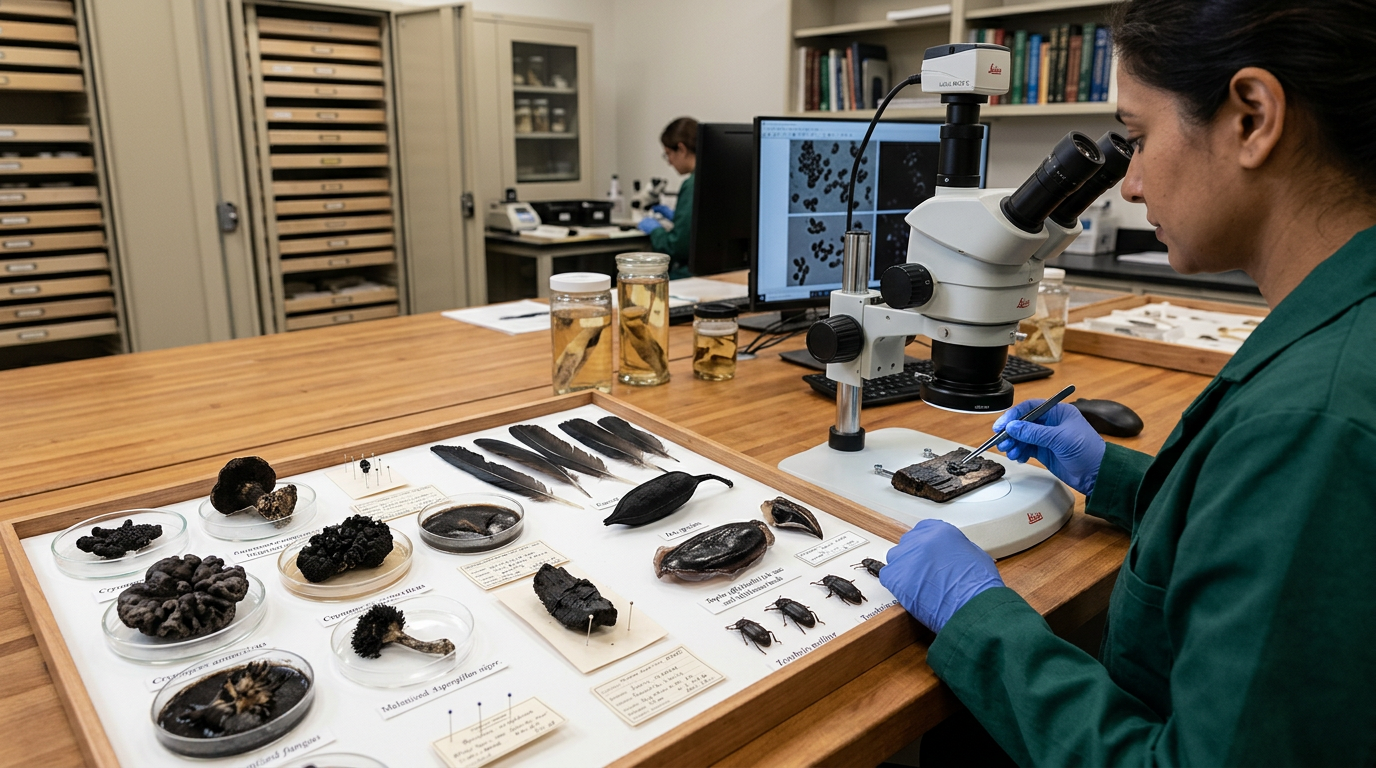
Melanin has survived nearly every mass extinction, adapted to every environment, and appears in organisms separated by billions of years of evolution. Recent discoveries of radiation-feeding fungi suggest this ancient molecule may be far more than a protective pigment — it could be a fundamental component of life's energy machinery.
When the Chernobyl nuclear reactor exploded in 1986, scientists expected the exclusion zone to become a biological wasteland. Instead, they discovered something extraordinary: certain fungi weren't just surviving the intense radiation — they were thriving on it. These melanized fungi, rich in the same dark pigment found in human skin and hair, were actually growing toward radiation sources, using gamma rays as an energy source much like plants use sunlight.
This discovery has profound implications for our understanding of melanin's role in biology. If organisms can harness ionizing radiation for energy through melanin-based systems, it suggests this molecule may represent one of life's most ancient and versatile energy conversion mechanisms — one that has persisted across all domains of life for nearly four billion years.
The Universal Language of Melanin
Melanin's evolutionary persistence is remarkable. The molecule appears in bacteria, fungi, plants, and animals, often in organisms with no recent common ancestor. This convergent evolution — the independent development of similar traits in unrelated lineages — typically signals that a characteristic provides fundamental survival advantages.
In bacteria like Streptomyces, melanin production correlates with enhanced survival under oxidative stress and UV exposure. Marine bacteria synthesize melanin-like compounds that appear to facilitate electron transport chains. Fungal melanin, particularly in pathogenic species like Cryptococcus neoformans, provides protection against host immune responses and environmental stressors.
But perhaps most intriguingly, plant melanin — found in seed coats, root tips, and areas of mechanical stress — demonstrates electrical conductivity that varies with hydration levels. Research by Mostert and colleagues has shown that eumelanin's conductivity can increase by several orders of magnitude when hydrated, suggesting it may function as a biological semiconductor with properties that change based on cellular conditions.
This universal distribution implies melanin serves functions far more fundamental than the UV protection role typically emphasized in human biology textbooks. The molecule's ability to interact with electromagnetic radiation across an enormous spectrum — from radio waves to gamma rays — positions it as a potential interface between living systems and the energetic environment.
Radiotrophic Life: Melanin as an Energy Harvester
The fungi discovered at Chernobyl represent a class of organisms called radiotrophic — literally "radiation-eating" — organisms. Species like Cladosporium sphaerospermum and Cryptococcus neoformans demonstrate enhanced growth in high-radiation environments, with melanin content directly correlating with radiation tolerance and utilization.
Arturo Solís Herrera's research group has proposed that melanin can split water molecules when exposed to electromagnetic radiation, similar to photosynthesis but across a much broader spectrum. This melanin-mediated water splitting could generate hydrogen ions and free electrons — the basic currency of cellular energy systems. Unlike chlorophyll, which captures only specific wavelengths of visible light, melanin's broadband absorption allows it to harvest energy from infrared, visible, UV, and even ionizing radiation.
The implications extend beyond terrestrial life. If melanin can convert radiation to usable energy, it could explain how life might persist in high-radiation environments throughout the universe — from Jupiter's moon Europa to the vicinity of neutron stars. The molecule's stability under extreme conditions, combined with its energy conversion capabilities, makes it a prime candidate for astrobiology research.
The Semiconductor Within: Melanin's Electronic Properties
Melanin's most fascinating property may be its behavior as a biological semiconductor. John McGinness's pioneering work in the 1970s demonstrated that melanin exhibits a switching behavior under electrical stimulation, with resistance changes that could theoretically support information processing. The molecule maintains stable free radicals detectable by electron paramagnetic resonance (EPR), indicating unpaired electrons that could participate in charge transport.
Recent biophysical studies have revealed melanin's bandgap energy of approximately 1.85 electron volts — placing it in the range of technologically useful semiconductors. More remarkably, this bandgap appears tunable based on hydration, pH, and the presence of metal ions. In biological systems, this could allow melanin to function as a dynamic electrical component that responds to cellular conditions.
The presence of melanin in electrically active tissues supports this hypothesis. Neuromelanin accumulates in dopaminergic neurons of the substantia nigra, precisely the brain region responsible for motor control and electrical signaling. While traditionally viewed as a byproduct of dopamine metabolism, neuromelanin's semiconductor properties suggest it might actively participate in neural computation.
Similarly, melanin's concentration in the inner ear, retinal pigment epithelium, and other sensory organs positions it to potentially modulate bioelectrical signals. Michael Levin's work on bioelectricity has shown that electrical patterns control morphogenesis, regeneration, and even cancer suppression. Melanin's electrical properties could make it a key component in these bioelectric control systems.
Evolutionary Implications: The Energy Revolution Hypothesis
The persistence of melanin across evolutionary time suggests it may have been present in some of Earth's earliest life forms. If early organisms could harness environmental radiation through melanin-based systems, it would represent an energy source available long before photosynthesis evolved — and one that would remain available in environments where sunlight cannot penetrate.
This radiation-first hypothesis for early life energy systems could explain several puzzles in evolutionary biology. How did life persist during "Snowball Earth" periods when ice covered most of the planet's surface? How did deep-sea organisms develop complex metabolisms without access to solar energy? Melanin-based energy conversion could provide answers.
The molecule's ability to chelate metals and neutralize reactive oxygen species would have been crucial in Earth's early, high-radiation environment. As atmospheric oxygen levels rose and UV radiation increased due to ozone formation, melanin's protective functions would have become equally important. This dual role — energy conversion and protection — could explain why natural selection has maintained melanin systems across such diverse lineages.
Modern extremophiles support this hypothesis. Organisms thriving in high-radiation environments, from uranium-rich soils to the cooling pools of nuclear reactors, consistently show elevated melanin production. These organisms may be evolutionary throwbacks to ancient radiation-based metabolisms, persisting in ecological niches that mirror early Earth conditions.
Key Takeaways
• Melanin's presence across all domains of life through convergent evolution indicates fundamental biological importance beyond pigmentation or UV protection.
• Radiotrophic fungi at Chernobyl demonstrate that melanin can enable organisms to use ionizing radiation as an energy source, challenging conventional understanding of biological energy systems.
• Melanin's semiconductor properties, including a tunable 1.85eV bandgap and stable free radicals, position it as a potential component in biological electrical systems and information processing.
• The molecule's broadband electromagnetic absorption capabilities could represent an ancient energy conversion mechanism that preceded and complements photosynthesis.
• Neuromelanin's accumulation in electrically active brain regions suggests possible roles in neural computation and bioelectric signaling beyond traditional metabolic byproduct functions.
• The radiation-first hypothesis for early life energy systems could explain melanin's evolutionary persistence and the survival of complex organisms in extreme environments throughout Earth's history.
References
McGinness, J., Corry, P., & Proctor, P. "Amorphous semiconductor switching in melanins." Science 183(4127), 853-855 (1974).
Dadachova, E., et al. "Ionizing radiation changes the electronic properties of melanin and enhances the growth of melanized fungi." PLoS ONE 2(5), e457 (2007). DOI: 10.1371/journal.pone.0000457
Mostert, A.B., et al. "Role of semiconductivity and ion transport in the electrical conduction of melanin." Proceedings of the National Academy of Sciences 109(23), 8943-8947 (2012).
Nosanchuk, J.D. & Casadevall, A. "The contribution of melanin to microbial pathogenesis." Cellular Microbiology 5(4), 203-223 (2003).
Solís-Herrera, A., Arias-Esparza, M.C., & Solís-Arias, R.I. "The unexpected capacity of melanin to dissociate the water molecule fills the gap between the life before and after ATP." Biomedical Research 21(2), 224-226 (2010).
Levin, M. "Bioelectric mechanisms in regeneration: Unique aspects and future perspectives." Seminars in Cell & Developmental Biology 20(5), 543-556 (2009).
Casadevall, A., Rosas, A.L., & Nosanchuk, J.D. "Melanin and virulence in Cryptococcus neoformans." Current Opinion in Microbiology 3(4), 354-358 (2000).