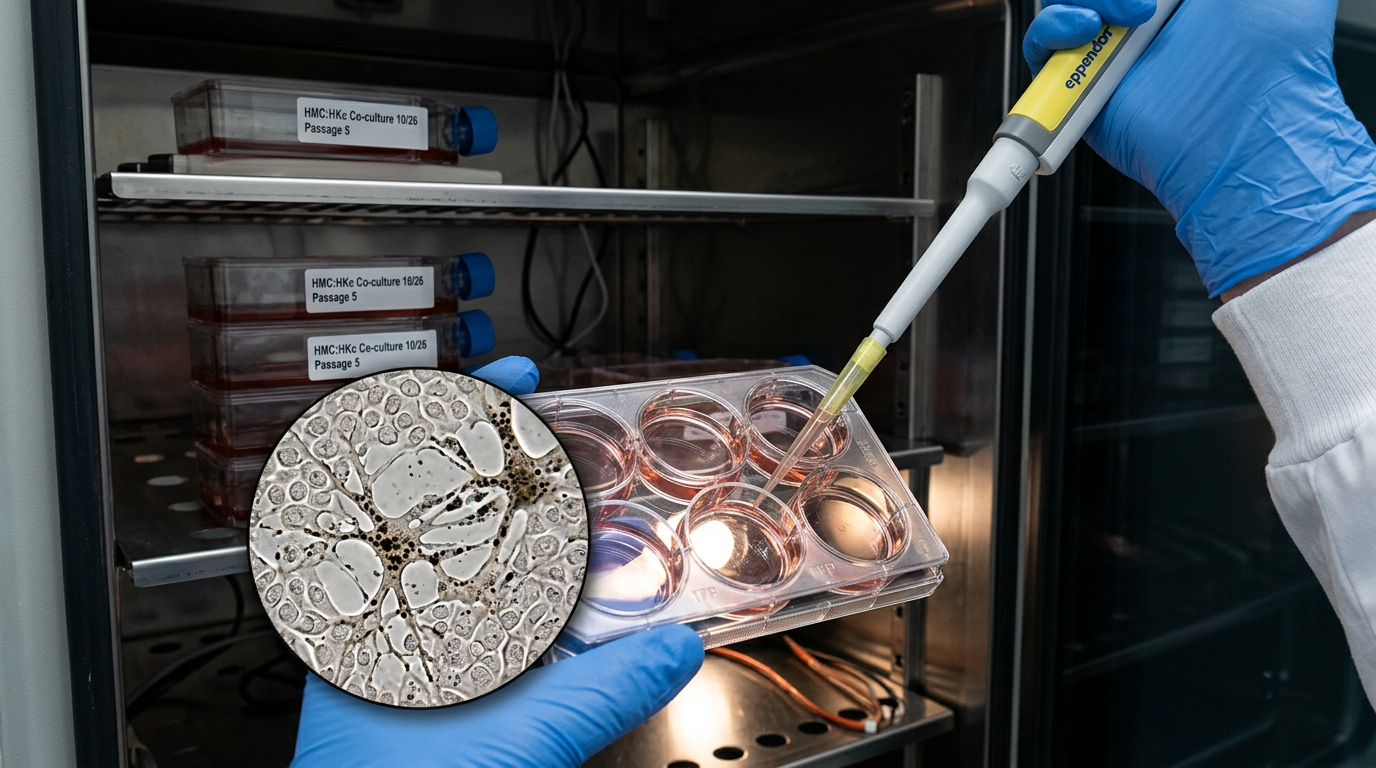
Melanocytes function as sophisticated cellular sensors and communicators, using their neural crest heritage and dendritic architecture to monitor tissue health and coordinate responses far beyond simple pigment production. Their bioelectric properties and extensive intercellular networks position them as critical players in skin homeostasis, wound healing, and potentially systemic health surveillance.
The human epidermis contains approximately 1,500 melanocytes per square millimeter, each extending dendritic processes to contact 30-40 keratinocytes in what dermatologists call the epidermal melanin unit. But viewing this arrangement merely as a pigment delivery system misses a profound biological reality: melanocytes are doing far more than manufacturing and distributing melanin granules. They are functioning as bioelectric sentinels, continuously sampling their microenvironment and orchestrating cellular responses through mechanisms that leverage both their unique neural heritage and their remarkable biomaterial—melanin itself.
Recent investigations into melanocyte behavior reveal a cell type that operates more like a neuron than a simple pigment factory. These cells maintain resting membrane potentials around -70mV, similar to neurons, and respond to various stimuli with rapid changes in bioelectric activity. When researchers at the University of California, Irvine, measured calcium signaling in cultured melanocytes, they discovered that these cells could propagate signals across their dendritic networks within milliseconds—speeds that suggest active bioelectric communication rather than passive diffusion.
Neural Crest Legacy: The Electrical Foundation
The embryonic origin of melanocytes provides crucial insight into their adult function. During early development, neural crest cells migrate from the developing nervous system to populate diverse tissues, giving rise to neurons, glial cells, and melanocytes. This shared lineage explains why melanocytes retain many neuronal characteristics, including the expression of neuronal markers like nestin and the ability to synthesize neurotransmitters.
Dr. Lukas Sommer's group at the University of Zurich has demonstrated that melanocytes can produce and respond to dopamine, norepinephrine, and acetylcholine. More intriguingly, they maintain voltage-gated calcium channels and can generate action potential-like responses when stimulated. This bioelectric machinery appears to be intimately connected to melanin synthesis itself—when researchers blocked calcium channels in melanocytes, melanin production decreased dramatically, suggesting that electrical activity directly regulates pigmentation.
The dendritic architecture of melanocytes further supports their role as cellular sensors. Unlike most epidermal cells, melanocytes extend long, branching processes that can span 100-200 micrometers, creating an extensive surveillance network throughout the epidermis. These dendrites contain high concentrations of melanosomes, but they also house mitochondria, endoplasmic reticulum, and importantly, ion channels that could support bioelectric signaling.
Melanosome Transfer: More Than Pigment Delivery
The transfer of melanosomes from melanocytes to keratinocytes has long been understood as a photoprotective mechanism, but emerging evidence suggests this process serves additional functions related to cellular communication and stress response. Melanosomes are not simply inert pigment granules—they are complex organelles containing melanin polymers with semiconductor properties, including a bandgap of approximately 1.85 electron volts and the ability to conduct both electrons and protons.
Research by Dr. Elena Oancea at Brown University has revealed that melanosomes can influence keratinocyte behavior in ways that extend far beyond UV protection. When keratinocytes receive melanosomes, they exhibit altered gene expression patterns, modified inflammatory responses, and enhanced DNA repair capacity. The melanin within these organelles appears to function as a biological semiconductor, potentially modulating cellular electrical activity and redox chemistry.
The transfer process itself involves sophisticated cell-cell communication. Melanocytes use specialized structures called dendrite tips to deliver melanosomes, and this delivery is regulated by various signals including UV exposure, inflammatory cytokines, and mechanical stress. Importantly, the electrical properties of melanin may play a role in this transfer—studies have shown that melanosomes can respond to electrical fields, and their movement within dendrites correlates with changes in cellular membrane potential.
Bioelectric Communication Networks
Perhaps most intriguingly, melanocytes appear to participate in bioelectric signaling networks that coordinate responses across the epidermis. Michael Levin's laboratory at Tufts University has pioneered the study of bioelectric patterns in development and regeneration, demonstrating that cells use electrical signals to communicate information about position, identity, and growth state. While much of this work has focused on other cell types, emerging evidence suggests melanocytes are active participants in these bioelectric networks.
Melanocytes express various ion channels, including potassium channels, calcium channels, and chloride channels, that could support bioelectric signaling. When researchers applied electrical stimulation to cultured skin, melanocytes showed rapid responses in calcium signaling and changes in melanin synthesis. More remarkably, these responses could propagate from stimulated melanocytes to neighboring unstimulated cells, suggesting that melanocytes can both receive and transmit bioelectric information.
The stable free radicals present in melanin may enhance this bioelectric communication capacity. Electron paramagnetic resonance (EPR) studies have shown that melanin contains approximately 10^17 unpaired electrons per gram, creating a reservoir of charge carriers that could support electrical signaling. Dr. John McGinness's early work at the Naval Research Laboratory demonstrated that melanin could function as a biological semiconductor switch, and recent studies suggest that hydrated melanin exhibits proton conductivity that increases with moisture content.
Clinical Implications and Future Directions
Understanding melanocytes as bioelectric sentinels opens new perspectives on skin health and disease. Vitiligo, traditionally viewed as an autoimmune attack on melanocytes, might also involve disruption of bioelectric communication networks. Similarly, melanoma development could be understood not just as uncontrolled pigment cell growth, but as a breakdown in the bioelectric regulation that normally constrains cellular behavior.
The wound healing process provides another context where melanocyte bioelectric function may be crucial. During skin repair, melanocytes migrate to wound sites and participate in tissue regeneration. Their ability to sense electrical fields and communicate with other cell types could make them important coordinators of the healing response, helping to guide keratinocyte migration and regulate inflammatory processes.
Key Takeaways
• Melanocytes retain neuronal characteristics from their neural crest origin, including voltage-gated ion channels and the ability to generate bioelectric signals similar to action potentials.
• The dendritic architecture of melanocytes creates an extensive surveillance network throughout the epidermis, with each melanocyte contacting 30-40 keratinocytes through processes spanning up to 200 micrometers.
• Melanosome transfer involves more than pigment delivery—these organelles contain semiconductor melanin that can influence keratinocyte electrical activity and cellular behavior.
• Melanin's stable free radicals and proton conductivity properties may enable melanocytes to function as bioelectric signal processors and transmitters within epidermal networks.
• Clinical conditions like vitiligo and melanoma may involve disruptions in melanocyte bioelectric communication, suggesting new therapeutic approaches beyond current treatments.
• The bioelectric properties of melanocytes position them as potential coordinators of wound healing and tissue homeostasis through electrical field sensing and intercellular communication.
References
McGinness, J., Corry, P., & Proctor, P. "Amorphous semiconductor switching in melanins." Science 183(4127), 853-855 (1974).
Oancea, E., Vriens, J., Brauchi, S., Jun, J., Splawski, I., & Clapham, D.E. "TRPM1 forms ion channels associated with melanin content in melanocytes." Science Signaling 2(70), ra21 (2009).
Adameyko, I., Lallemend, F., Aquino, J.B., Pereira, J.A., Topilko, P., Müller, T., Fritz, N., Beljajeva, A., Mochii, M., Liste, I., Usoskin, D., Suter, U., Birchmeier, C., & Ernfors, P. "Schwann cell precursors from nerve innervation are a cellular origin of melanocytes in skin." Cell 139(2), 366-379 (2009).
Levin, M. "Bioelectric mechanisms in regeneration: Unique aspects and future perspectives." Seminars in Cell & Developmental Biology 20(5), 543-556 (2009).
Schiaffino, M.V. "Signaling pathways in melanosome biogenesis and pathology." International Journal of Biochemistry & Cell Biology 42(7), 1094-1104 (2010).
Slominski, A., Tobin, D.J., Shibahara, S., & Wortsman, J. "Melanin pigmentation in mammalian skin and its hormonal regulation." Physiological Reviews 84(4), 1155-1228 (2004).
Raposo, G., & Marks, M.S. "Melanosomes—dark organelles enlighten endosomal membrane transport." Nature Reviews Molecular Cell Biology 8(10), 786-797 (2007).