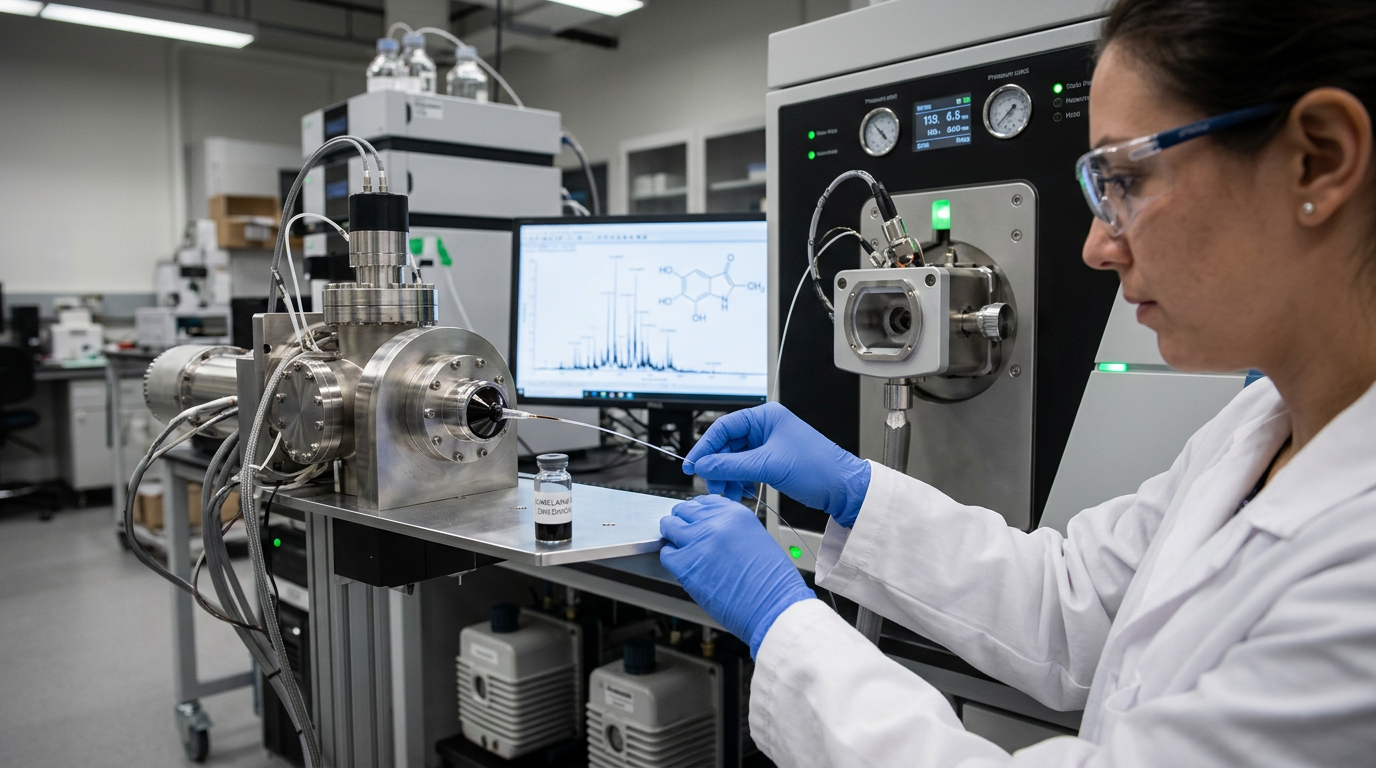
Eumelanin and pheomelanin represent one of biology's most striking examples of how subtle structural differences can produce dramatically opposite functional outcomes. While both pigments arise from the same tyrosine precursor pathway, their distinct molecular architectures create fundamentally different relationships with light, oxidation, and cellular protection. Understanding these differences illuminates why melanin diversity evolved—and why it matters for human health, evolutionary biology, and emerging biotechnology applications.
The difference between life and death can sometimes come down to a single chemical bond. In the world of melanin biochemistry, the presence or absence of sulfur creates two pigments with radically opposing relationships to the very light they're meant to manage. Eumelanin, the dark brown-black pigment that dominates in deeply pigmented skin and hair, functions as nature's nearly perfect photoprotective shield. Pheomelanin, the red-yellow pigment prominent in fair skin and red hair, paradoxically becomes a photosensitizer under the same UV radiation it should theoretically protect against.
This fundamental dichotomy emerges from their molecular architectures. Eumelanin forms through the oxidative polymerization of 5,6-dihydroxyindole (DHI) and 5,6-dihydroxyindole-2-carboxylic acid (DHICA) monomers, creating a complex heteropolymer with extensive π-conjugated systems. Pheomelanin, in contrast, incorporates cysteine during its biosynthesis, leading to benzothiazine and benzothiazole structural units that fundamentally alter its electronic properties and photochemical behavior.
Eumelanin: The Molecular Fortress
Eumelanin's protective prowess stems from its unique molecular organization. The polymer consists of stacked DHI and DHICA units connected through various carbon-carbon and carbon-nitrogen bonds, creating what researchers describe as a "chemical black hole" for electromagnetic radiation. This structure enables eumelanin to absorb light across an extraordinarily broad spectrum—from UV through visible and into near-infrared wavelengths—with an absorption coefficient that increases monotonically toward shorter wavelengths.
The key to eumelanin's photoprotective function lies in its ability to convert absorbed photon energy into harmless heat through a process called internal conversion. When UV photons strike eumelanin, the energy rapidly cascades down through vibrational states within femtoseconds to picoseconds, dissipating as thermal energy before any photochemical damage can occur. This process is so efficient that eumelanin can handle photon energies up to 6.2 eV without generating significant amounts of reactive oxygen species.
Research by Meredith and Sarna demonstrated that eumelanin's broadband absorption arises from its chemical disorder—the random incorporation of different monomer units and linking patterns creates a distribution of electronic states rather than discrete energy levels. This disorder, rather than being a flaw, is actually the source of eumelanin's remarkable photoprotective versatility. The pigment essentially functions as a biological semiconductor with a bandgap around 1.85 eV, exhibiting both electron and proton conductivity that increases with hydration.
The redox properties of eumelanin further enhance its protective role. The polymer maintains a population of stable organic free radicals detectable by electron paramagnetic resonance (EPR) spectroscopy. These radicals can scavenge other reactive species, providing an additional layer of antioxidant protection. Importantly, eumelanin's radical population remains relatively stable under UV irradiation, unlike many other biological molecules that generate harmful radicals when photodamaged.
Pheomelanin: The Photochemical Paradox
Pheomelanin presents a striking contrast to its eumelanin cousin. The incorporation of sulfur from cysteine during biosynthesis creates a polymer built around benzothiazine and benzothiazole units, fundamentally altering the pigment's relationship with light and oxygen. While pheomelanin does absorb UV radiation—particularly in the UV-B range around 280-320 nm—its photochemical response generates reactive oxygen species rather than safely dissipating energy as heat.
Studies by Chedekel and colleagues revealed that pheomelanin photodegradation produces superoxide anion, hydrogen peroxide, and hydroxyl radicals under UV exposure. This photosensitizing behavior stems from the benzothiazine units' ability to undergo photoinduced electron transfer reactions with molecular oxygen. Rather than the rapid internal conversion that characterizes eumelanin, pheomelanin's excited states have sufficient lifetime to interact with cellular components and atmospheric oxygen.
The sulfur content in pheomelanin—typically 8-12% by weight compared to eumelanin's negligible sulfur—creates additional vulnerabilities. Sulfur-containing functional groups are particularly susceptible to oxidative modification, and pheomelanin degradation products can include potentially mutagenic compounds. This helps explain epidemiological observations linking red hair and fair skin (high pheomelanin content) with increased melanoma risk, particularly in sun-exposed populations.
Interestingly, pheomelanin's redox properties also differ markedly from eumelanin. While eumelanin can cycle between oxidized and reduced states relatively reversibly, pheomelanin tends toward irreversible oxidative degradation under physiological conditions. This difference has profound implications for the pigment's long-term stability and protective function in living tissues.
Evolutionary and Biomedical Implications
The existence of two melanins with opposing photochemical properties raises fascinating questions about evolutionary trade-offs and adaptation. Pheomelanin's persistence despite its photosensitizing properties suggests it confers advantages that outweigh its UV-related risks in certain environments or genetic backgrounds. Some researchers propose that pheomelanin might enhance vitamin D synthesis in low-UV environments, or that its lighter color provides camouflage advantages in specific ecological niches.
From a biomedical perspective, understanding eumelanin-pheomelanin differences has direct clinical relevance. The ratio of these pigments, rather than total melanin content alone, appears to be a better predictor of UV sensitivity and skin cancer risk. This insight is driving development of more sophisticated approaches to personalized sun protection and melanoma risk assessment.
The contrasting properties of these melanins also inspire biomimetic applications. Eumelanin's efficient energy dissipation and broadband absorption make it attractive for photoprotective coatings and organic electronics, while even pheomelanin's photosensitizing properties might find applications in photodynamic therapy or solar energy conversion systems.
Key Takeaways
• Eumelanin and pheomelanin arise from the same biosynthetic pathway but incorporate different monomers—DHI/DHICA versus cysteine-modified benzothiazines—creating fundamentally different molecular architectures.
• Eumelanin functions as a highly efficient photoprotective agent through rapid internal conversion of photon energy to heat, while pheomelanin paradoxically generates reactive oxygen species under UV exposure.
• The chemical disorder in eumelanin's polymer structure is actually advantageous, creating broadband absorption and stable energy dissipation across the electromagnetic spectrum.
• Sulfur incorporation in pheomelanin (8-12% by weight) makes it more susceptible to oxidative degradation and photochemical damage compared to eumelanin's negligible sulfur content.
• The eumelanin-to-pheomelanin ratio, rather than total pigment content, appears to be a better predictor of UV sensitivity and photodamage risk in human populations.
• These contrasting melanin properties offer insights for both evolutionary biology and practical applications in photoprotection, biomimetic materials, and personalized medicine.
References
Meredith, P. & Sarna, T. "The physical and chemical properties of eumelanin." Pigment Cell Research 19(6), 572-594 (2006).
Chedekel, M.R. et al. "Photodestruction of pheomelanin: role of oxygen." Proceedings of the National Academy of Sciences 75(11), 5395-5399 (1978).
Ito, S. & Wakamatsu, K. "Chemistry of mixed melanogenesis—pivotal roles of dopaquinone." Photochemistry and Photobiology 84(3), 582-592 (2008).
McGinness, J. et al. "Amorphous semiconductor switching in melanins." Science 183(4127), 853-855 (1974).
Sarna, T. & Swartz, H.M. "The physical properties of melanins." The Pigmentary System (eds. Nordlund, J.J. et al.) 333-357 (1998).
Wakamatsu, K. et al. "Melanins and melanogenesis: methods, standards, protocols." Pigment Cell & Melanoma Research 26(5), 616-633 (2013).