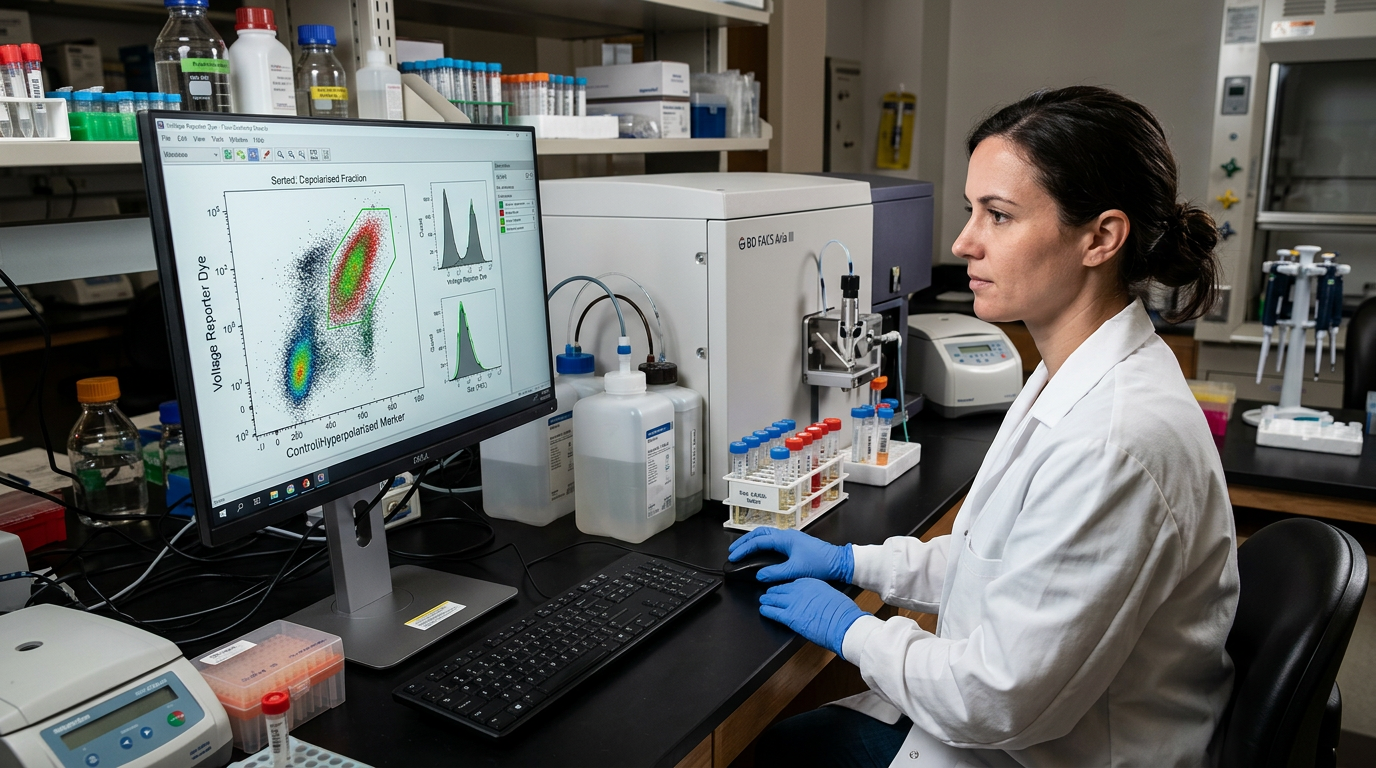
Cancer may not just be a genetic disease—it could be an electrical one. New research reveals that the voltage across cell membranes acts as a master switch controlling whether cells behave normally or turn malignant, opening unexpected pathways for both understanding and treating cancer.
When most people think about cancer, they envision DNA mutations spiraling out of control. But what if the real story begins with something far more fundamental—the electrical charge that every living cell maintains across its membrane? This bioelectric perspective on cancer is reshaping our understanding of how tumors form and, surprisingly, pointing toward melanin as a potential player in the body's electrical defense systems.
The Bioelectric Cancer Switch
Michael Levin's laboratory at Tufts University has uncovered a startling pattern: membrane potential—the voltage difference across a cell's outer boundary—appears to function as a binary switch between normal and cancerous behavior. Healthy cells typically maintain a membrane potential around -50 to -70 millivolts, while cells that have depolarized to less negative values (closer to -20mV) show a dramatically increased likelihood of becoming malignant.
This isn't merely correlation. When Levin's team artificially hyperpolarized cells using ion channel modulators—essentially making them more electrically negative—they could suppress tumor formation even in the presence of known carcinogens. Conversely, depolarizing normal cells pushed them toward cancerous behavior. The implications are profound: cancer might be as much an electrical disease as a genetic one.
The mechanism appears to center on voltage-gated ion channels, particularly potassium and sodium channels that control the flow of charged particles across cell membranes. These channels don't just maintain cellular voltage—they act as molecular sensors that translate electrical states into biochemical signals. When membrane potential shifts toward depolarization, it triggers cascades that promote cell division, suppress apoptosis (programmed cell death), and alter gene expression patterns in ways that favor malignancy.
Melanin as a Bioelectric Conductor
This bioelectric framework raises intriguing questions about melanin's role beyond photoprotection. Melanin exhibits semiconductor properties with a bandgap around 1.85 electron volts, positioning it in the range of organic semiconductors. More importantly, melanin demonstrates proton conductivity that increases dramatically with hydration—a property that could make it an active participant in cellular bioelectric signaling.
Recent studies have shown that melanin's electrical conductivity isn't just a curious biophysical property—it appears to be physiologically relevant. The polymer's ability to conduct both electrons and protons suggests it could function as a bioelectric interface, potentially helping to maintain or modulate the membrane potentials that Levin's work shows are so critical for preventing cancer.
Neuromelanin, found concentrated in dopaminergic neurons of the substantia nigra, offers a particularly compelling example. These neurons are both highly metabolically active and vulnerable to oxidative damage—conditions that would benefit from robust bioelectric regulation. The presence of melanin in these cells might help maintain the hyperpolarized states necessary for normal function while providing protection against the electrical dysregulation that could contribute to neurodegeneration.
Ion Channels, Voltage Gates, and Cellular Computation
The bioelectric control of cancer reveals cells as sophisticated electrical computers that process information through voltage changes and ion flows. Different ion channels act as molecular transistors, switching on or off based on membrane voltage and creating complex signaling networks that determine cell fate.
Voltage-gated sodium channels (VGSCs), typically associated with nerve impulses, are aberrantly expressed in many cancer types. These channels can depolarize cells and promote the electrical states associated with malignancy. Similarly, potassium channels like Kv11.1 help maintain hyperpolarized, cancer-resistant states—and their dysfunction is implicated in various tumors.
This electrical perspective explains why certain cancer treatments work. Some chemotherapy drugs and targeted therapies may succeed not just through their intended molecular mechanisms, but by inadvertently affecting cellular bioelectricity. Understanding these electrical effects could lead to more precise interventions that target the bioelectric signatures of cancer cells while sparing healthy tissue.
Implications for Melanin-Rich Tissues
The bioelectric cancer hypothesis has particular relevance for melanin-containing tissues. Melanocytes, the melanin-producing cells of the skin, exist in a unique electrical environment. They must balance the photoprotective benefits of melanin production with the metabolic costs and potential for oxidative stress. The semiconductor properties of melanin might help these cells maintain the hyperpolarized states that resist malignant transformation.
This could partially explain why certain types of melanoma show different electrical signatures than other skin cancers. If melanin normally helps maintain cancer-protective bioelectric states, then disruptions to this system—whether through genetic mutations affecting melanin synthesis or environmental factors that overwhelm melanin's protective capacity—could contribute to malignant transformation.
The brain presents another intriguing case. Neuromelanin accumulates with age in specific brain regions, and these same regions show altered electrical activity in neurodegenerative diseases. While the relationship between neuromelanin and bioelectricity remains largely unexplored, the convergence of electrical dysregulation and melanin-containing neurons in conditions like Parkinson's disease suggests important connections waiting to be discovered.
Key Takeaways
• Membrane potential acts as a master switch for cancer: cells with depolarized membranes (less negative than -20mV) show dramatically increased malignancy risk, while hyperpolarized cells resist tumor formation even in the presence of carcinogens.
• Ion channels function as molecular computers: voltage-gated sodium and potassium channels translate electrical states into biochemical signals that control cell division, death, and gene expression patterns.
• Melanin's semiconductor properties position it as a potential bioelectric regulator: with proton conductivity that increases with hydration and electron transport capabilities, melanin could help maintain the hyperpolarized states that resist cancer.
• Cancer treatment may work through unrecognized electrical mechanisms: some therapies might succeed by affecting cellular bioelectricity rather than just their intended molecular targets, suggesting new approaches to treatment design.
• Melanin-rich tissues may have unique electrical vulnerabilities: understanding how melanin contributes to bioelectric regulation could reveal why certain cancers develop in pigmented tissues and how electrical interventions might prevent or treat them.
• The bioelectric cancer hypothesis opens new research directions: investigating melanin's role in cellular voltage regulation could lead to novel diagnostic markers and therapeutic approaches for both cancer and neurodegeneration.
References
Levin, M. "Bioelectric signaling: Reprogrammable circuits underlying embryogenesis, regeneration, and cancer." Cell 184(8), 1971-1989 (2021). DOI: 10.1016/j.cell.2021.02.034
Yang, M. & Brackenbury, W.J. "Membrane potential and cancer progression." Frontiers in Physiology 4, 185 (2013). DOI: 10.3389/fphys.2013.00185
Sundelacruz, S., Levin, M., & Kaplan, D.L. "Role of membrane potential in the regulation of cell proliferation and differentiation." Stem Cell Reviews and Reports 5(3), 231-246 (2009). DOI: 10.1007/s12015-009-9080-2
McGinness, J., Corry, P., & Proctor, P. "Amorphous semiconductor switching in melanins." Science 183(4127), 853-855 (1974). DOI: 10.1126/science.183.4127.853
Mostert, A.B. "Melanin, the master of disguise." Journal of Materials Science: Materials in Medicine 24(10), 2297-2307 (2013). DOI: 10.1007/s10856-013-4960-x
Blackiston, D.J., McLaughlin, K.A., & Levin, M. "Bioelectric controls of cell proliferation: ion channels, membrane voltage and the cell cycle." Cell Cycle 8(21), 3527-3536 (2009). DOI: 10.4161/cc.8.21.9888