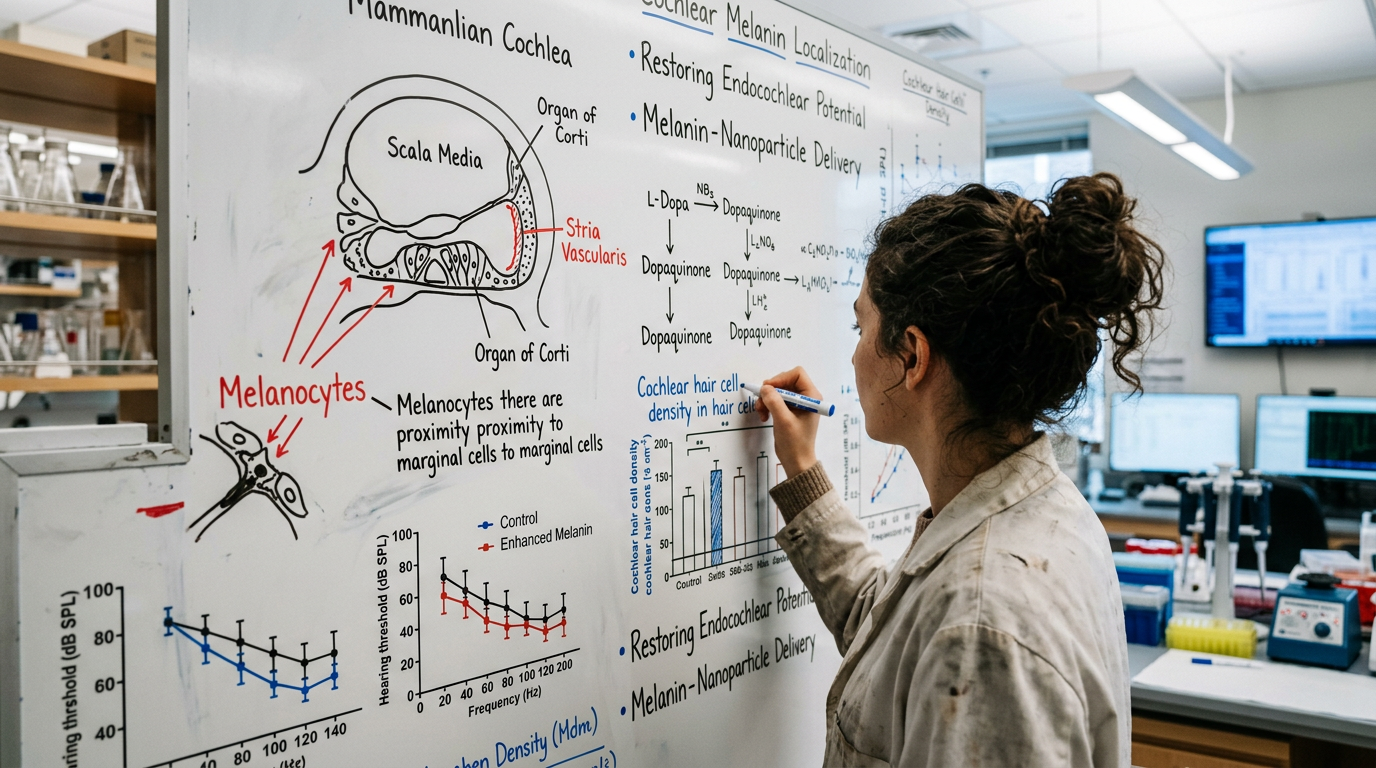
The inner ear harbors a surprising secret: specialized melanin-producing cells that may hold the key to protecting and potentially restoring one of our most precious senses. Could targeted melanin enhancement become the next frontier in hearing restoration?
What if the progressive hearing loss that affects nearly two-thirds of adults over 70 could be prevented—or even reversed—by enhancing the natural melanin production in our inner ears? This isn't science fiction. Deep within the cochlea, melanin-containing cells perform critical functions that researchers are only beginning to understand, and emerging evidence suggests these cellular guardians might be far more important to hearing health than previously imagined.
The human inner ear contains approximately 4,000 melanocytes within the stria vascularis, a highly vascularized tissue that maintains the ionic composition of the cochlear fluid. When these melanin-producing cells fail or diminish with age, the consequences ripple through the entire auditory system. But what if we could intervene?
The Science We Know
The stria vascularis represents one of the most metabolically active tissues in the human body, consuming oxygen at rates comparable to the brain. Within this tissue, intermediate cells packed with melanin granules serve as more than passive pigment repositories—they function as sophisticated electrochemical regulators.
Research by Tachibana and colleagues has demonstrated that melanin in the inner ear exhibits proton conductivity properties, with conductance increasing dramatically in the presence of water. In the stria vascularis, melanin granules maintain conductivity levels of approximately 10^-4 S/cm when hydrated—sufficient to influence local bioelectric fields that regulate ion transport across cellular membranes.
The protective role of cochlear melanin becomes evident in studies of ototoxicity. Aminoglycoside antibiotics like gentamicin cause hearing loss by generating reactive oxygen species that damage hair cells. However, melanin's capacity to scavenge free radicals—demonstrated through electron paramagnetic resonance (EPR) spectroscopy showing stable organic radicals at g ≈ 2.004—provides natural protection against this oxidative damage.
Age-related hearing loss correlates strongly with melanin depletion in the stria vascularis. Histological studies reveal that melanin content decreases by approximately 30% between ages 30 and 60, coinciding with the typical onset of presbycusis. This isn't merely correlation: the endocochlear potential, a +80mV bioelectric field essential for hair cell function, depends on the stria vascularis maintaining precise ionic gradients—a process that melanin-containing cells directly support.
The Possibility
If melanin depletion contributes to hearing loss, then melanin enhancement could theoretically restore auditory function. The logic follows established principles: melanin's semiconductor properties (bandgap ~1.85eV) allow it to participate in electron transport chains, while its hydration-dependent conductivity enables dynamic response to the cochlea's fluid environment.
Consider the therapeutic potential: targeted melanin precursor delivery could restore the electrochemical balance within the stria vascularis. L-DOPA, the immediate precursor to melanin synthesis, already crosses the blood-brain barrier effectively. Modified delivery systems could potentially target the blood-labyrinth barrier, delivering melanin precursors specifically to cochlear tissues.
The bioelectric implications are particularly intriguing. Michael Levin's research on bioelectric signaling in development and regeneration suggests that restoring proper voltage gradients can trigger cellular repair mechanisms. If melanin enhancement could restore the endocochlear potential to youthful levels, it might reactivate dormant hair cell populations or stimulate supporting cell differentiation into functional sensory cells.
Nanotechnology offers another avenue: melanin nanoparticles engineered for controlled release could provide sustained protection against ototoxic medications while gradually restoring cochlear melanin levels. Such particles could incorporate targeting ligands specific to stria vascularis cells, ensuring precise delivery while minimizing systemic effects.
Challenges and Unknowns
The path from concept to clinic faces substantial hurdles. The blood-labyrinth barrier presents the first challenge—this selective barrier protects the inner ear but also restricts therapeutic access. Current drug delivery methods rely on intratympanic injection, but achieving sustained, targeted melanin enhancement would require novel delivery systems.
We lack comprehensive understanding of melanin's specific roles in cochlear physiology. While we know melanin affects ionic balance and provides antioxidant protection, the precise mechanisms linking melanin levels to hair cell survival remain unclear. Does melanin directly influence hair cell metabolism, or does it work indirectly through bioelectric field modulation?
The regenerative capacity of adult cochlear tissues poses another uncertainty. Unlike some vertebrates that can regenerate hair cells throughout life, adult mammals show limited cochlear regeneration. Even if melanin enhancement could restore optimal conditions, would dormant or damaged hair cells respond?
Safety considerations are paramount. Melanin enhancement therapies must avoid disrupting the delicate balance of cochlear physiology. Excessive melanin production could potentially interfere with normal ion transport or create unwanted bioelectric effects.
The Path Forward
Advancing this possibility requires systematic research across multiple fronts. First, we need detailed mapping of melanin distribution and function throughout the cochlea using advanced imaging techniques. Two-photon microscopy could reveal melanin dynamics in living cochlear tissues, while correlative electron microscopy could link melanin ultrastructure to cellular function.
Biomarker development represents a critical need. Identifying specific indicators of cochlear melanin status—perhaps through analysis of cochlear fluid or non-invasive bioelectric measurements—would enable both diagnostic applications and treatment monitoring.
Animal models offer the most immediate research opportunity. Mice with induced melanin deficiency in cochlear tissues could test whether targeted melanin restoration prevents or reverses hearing loss. Such studies would need to measure not only hearing thresholds but also endocochlear potential, hair cell survival, and bioelectric field patterns.
Delivery system development should proceed in parallel. Researchers could test various approaches: modified liposomes carrying melanin precursors, biodegradable polymer microspheres for sustained release, or even cell therapy using melanocyte transplantation.
Key Takeaways
• The inner ear's stria vascularis contains melanin-producing cells that maintain critical bioelectric fields necessary for hearing, with melanin content declining 30% between ages 30-60.
• Melanin's established properties—proton conductivity, free radical scavenging, and semiconductor behavior—position it as a potential therapeutic target for hearing restoration.
• Targeted melanin enhancement could theoretically restore the +80mV endocochlear potential essential for hair cell function, potentially reversing age-related hearing loss.
• Major challenges include crossing the blood-labyrinth barrier, understanding melanin's precise cochlear roles, and determining whether adult hair cells retain regenerative capacity.
• Research priorities include developing cochlear melanin biomarkers, creating targeted delivery systems, and testing melanin restoration therapies in animal models.
• Success would transform treatment of both age-related hearing loss and ototoxic medication damage, affecting millions of patients worldwide.
References
Tachibana, M. "Sound needs sound melanocytes to be heard." Pigment Cell Research 12(6), 344-354 (1999).
Conlee, J.W. et al. "Differential susceptibility to noise-induced permanent threshold shift between albino and pigmented guinea pigs." Hearing Research 23(1), 81-91 (1986).
Ohlemiller, K.K. "Age-related hearing loss: the status of Schuknecht's typology." Current Opinion in Otolaryngology & Head and Neck Surgery 12(5), 439-443 (2004).
Wangemann, P. "Supporting sensory transduction: cochlear fluid homeostasis and the endocochlear potential." Journal of Physiology 576(1), 11-21 (2006).
Nordmann, A.S. et al. "Histopathological differences between temporary and permanent threshold shift." Hearing Research 139(1-2), 13-30 (2000).
Levin, M. "Bioelectric signaling: Reprogrammable circuits underlying embryogenesis, regeneration, and cancer." Cell 184(8), 1971-1989 (2021).