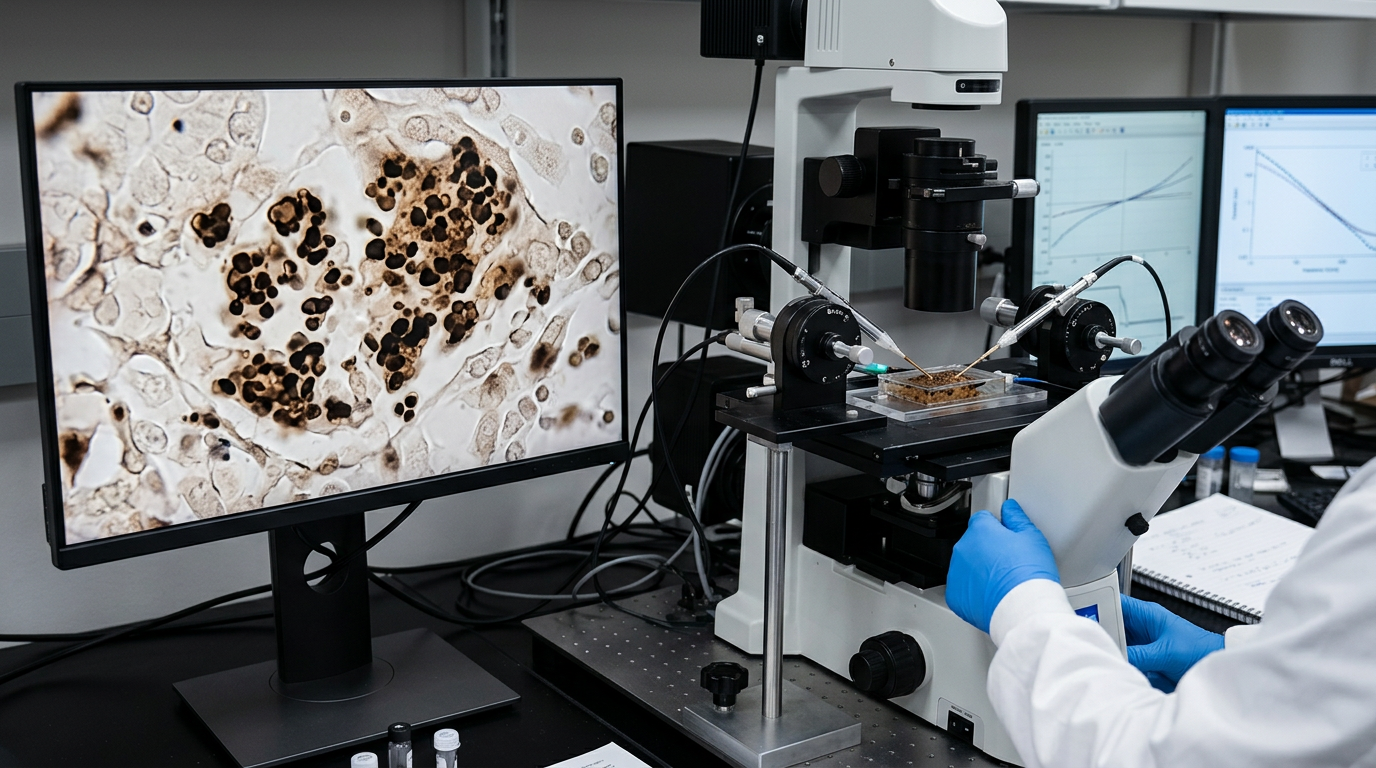
Exploring how the body's natural semiconductor could revolutionize early cancer detection by sensing the electrical fingerprints of malignant transformation.
What if the same pigment that protects our skin from ultraviolet radiation could also serve as an early warning system for cancer? This isn't science fiction—it's a logical extension of two well-established scientific facts: cancer cells exhibit dramatically altered electrical properties, and melanin functions as a biological semiconductor whose conductivity responds to local electrical fields. The convergence of these discoveries opens a tantalizing possibility for non-invasive cancer detection that could identify malignancies years before conventional imaging reveals their presence.
The Science We Know
The bioelectric landscape of cancer is remarkably consistent across different tumor types. Normal healthy cells maintain a membrane potential of approximately -70 millivolts, a voltage difference that drives essential cellular processes and maintains proper gene expression patterns. Cancer cells, however, exist in a state of chronic depolarization, with membrane potentials hovering around -20 millivolts. This isn't merely a consequence of malignancy—research by Michael Levin's group at Tufts University has demonstrated that depolarization can actually trigger oncogene expression and tumor formation.
The electrical disruption extends beyond individual cells. Tumors create bioelectric field distortions that propagate through surrounding tissues, altering ion flow patterns and creating detectable electrical gradients. These changes occur at the earliest stages of malignant transformation, often preceding the formation of detectable masses by months or years.
Meanwhile, melanin's electrical properties have been systematically characterized since the 1970s. Eumelanin, the dark pigment found in skin, hair, and eyes, exhibits semiconductor behavior with a bandgap of approximately 1.85 electron volts. More intriguingly, melanin's conductivity is not fixed—it responds dynamically to its electrical environment. When hydrated, melanin can conduct both electrons and protons, and its conductivity increases in the presence of electrical fields. John McGinness's pioneering work at the Naval Research Laboratory demonstrated that melanin could function as a biological switch, changing its electrical resistance by orders of magnitude in response to applied voltages.
The Possibility
If cancer creates detectable bioelectric disturbances, and melanin's conductivity responds to electrical fields, then melanin-based sensors could theoretically detect malignancies through their electrical signatures. The logic is compelling: place melanin-containing sensors at strategic locations on the body, monitor their conductivity patterns, and look for the characteristic electrical fingerprints of cancerous tissue.
Consider how this might work in practice. Wearable melanin sensors—perhaps integrated into clothing or adhesive patches—could continuously monitor the bioelectric environment of different body regions. Breast tissue, prostate, lung, and other cancer-prone organs each have characteristic baseline electrical patterns. When cells in these regions begin their malignant transformation, the resulting membrane depolarization would create detectable electrical field changes.
The melanin sensors would respond to these field alterations by changing their own conductivity. Advanced signal processing algorithms could distinguish between normal bioelectric fluctuations—caused by heartbeat, breathing, or muscle movement—and the persistent, progressive electrical signatures characteristic of developing tumors. The system might detect pre-cancerous electrical shifts months or even years before tumors become large enough for conventional detection methods.
This approach could be particularly powerful for monitoring high-risk individuals. Someone with a strong family history of breast cancer, for instance, could wear melanin-based sensors that continuously assess the bioelectric status of breast tissue. The sensors would establish a personal baseline and alert to deviations that suggest malignant transformation is beginning.
Challenges and Unknowns
Several significant technical barriers stand between this concept and clinical reality. First, we lack detailed maps of how cancer's bioelectric signatures propagate through different tissue types. While we know tumors create electrical disturbances, the precise patterns—and how they vary by cancer type, location, and stage—remain largely uncharacterized.
The signal-to-noise problem presents another major challenge. The human body generates constant electrical activity from heart, brain, muscle, and nerve function. Distinguishing cancer-specific bioelectric signals from this background noise would require sophisticated filtering and pattern recognition capabilities that don't yet exist.
Melanin's response to biological electrical fields, while demonstrated in laboratory settings, hasn't been systematically studied in the complex, multi-layered environment of living tissue. We don't know how factors like skin thickness, subcutaneous fat, muscle tissue, and individual genetic variations might affect melanin sensor sensitivity and specificity.
There's also the fundamental question of detection range. How close must a melanin sensor be to detect the bioelectric signature of a developing tumor? Can sensors placed on the skin surface detect electrical changes from tumors deep within the body, or would this approach be limited to superficial malignancies?
The Path Forward
Realizing melanin-based cancer biosensors would require coordinated research across multiple disciplines. Bioelectric mapping studies must first characterize the electrical signatures of different cancer types throughout their development. This would involve simultaneous electrical measurements and conventional imaging to correlate bioelectric changes with tumor progression.
In parallel, melanin sensor engineering needs systematic development. Researchers must optimize melanin formulations for maximum sensitivity to biological electrical fields while maintaining stability in physiological conditions. This might involve creating synthetic melanin analogs or hybrid organic-inorganic materials that combine melanin's biocompatibility with enhanced electrical responsiveness.
Signal processing algorithms represent another critical research frontier. Machine learning approaches could potentially identify cancer-specific electrical patterns within the complex bioelectric landscape of the human body. Training such systems would require large datasets correlating electrical measurements with confirmed cancer diagnoses.
Clinical validation would proceed through carefully designed studies. Initial work might focus on monitoring known cancer patients to establish proof-of-concept, followed by prospective studies of high-risk populations to assess the technology's predictive capabilities.
Key Takeaways
• Cancer cells consistently exhibit depolarized membrane potentials (-20mV vs -70mV normal), creating detectable bioelectric field disturbances that precede tumor formation.
• Melanin functions as a biological semiconductor whose conductivity responds dynamically to local electrical fields, making it a candidate material for bioelectric sensing applications.
• The theoretical framework exists for melanin-based wearable sensors that could detect cancer through bioelectric signature changes, potentially identifying malignancies before conventional imaging methods.
• Major technical challenges include signal-to-noise discrimination, tissue penetration limitations, and the need for comprehensive bioelectric mapping of different cancer types.
• Successful development would require coordinated research in bioelectric characterization, melanin sensor engineering, and machine learning-based signal processing.
• Such technology could revolutionize cancer screening by enabling continuous, non-invasive monitoring of high-risk individuals for early signs of malignant transformation.
References
Levin, M. "Bioelectric signaling: Reprogrammable circuits underlying embryogenesis, regeneration, and cancer." Cell 184(8), 1971-1989 (2021). DOI: 10.1016/j.cell.2021.02.034
Yang, M. & Brackenbury, W.J. "Membrane potential and cancer progression." Frontiers in Physiology 4, 185 (2013). DOI: 10.3389/fphys.2013.00185
McGinness, J., Corry, P. & Proctor, P. "Amorphous semiconductor switching in melanins." Science 183(4127), 853-855 (1974). DOI: 10.1126/science.183.4127.853
Mostert, A.B. "Melanin, the what, the why and the how: An introductory review for materials scientists interested in flexible and versatile polymers." Polymers 13(10), 1670 (2021). DOI: 10.3390/polym13101670
Sundelacruz, S., Levin, M. & Kaplan, D.L. "Role of membrane potential in the regulation of cell proliferation and differentiation." Stem Cell Reviews and Reports 5(3), 231-246 (2009). DOI: 10.1007/s12015-009-9080-2
Binhi, V.N. & Prato, F.S. "Biological effects of the hypomagnetic field: An analytical review of experiments and theories." PLoS One 12(6), e0179340 (2017). DOI: 10.1371/journal.pone.0179340