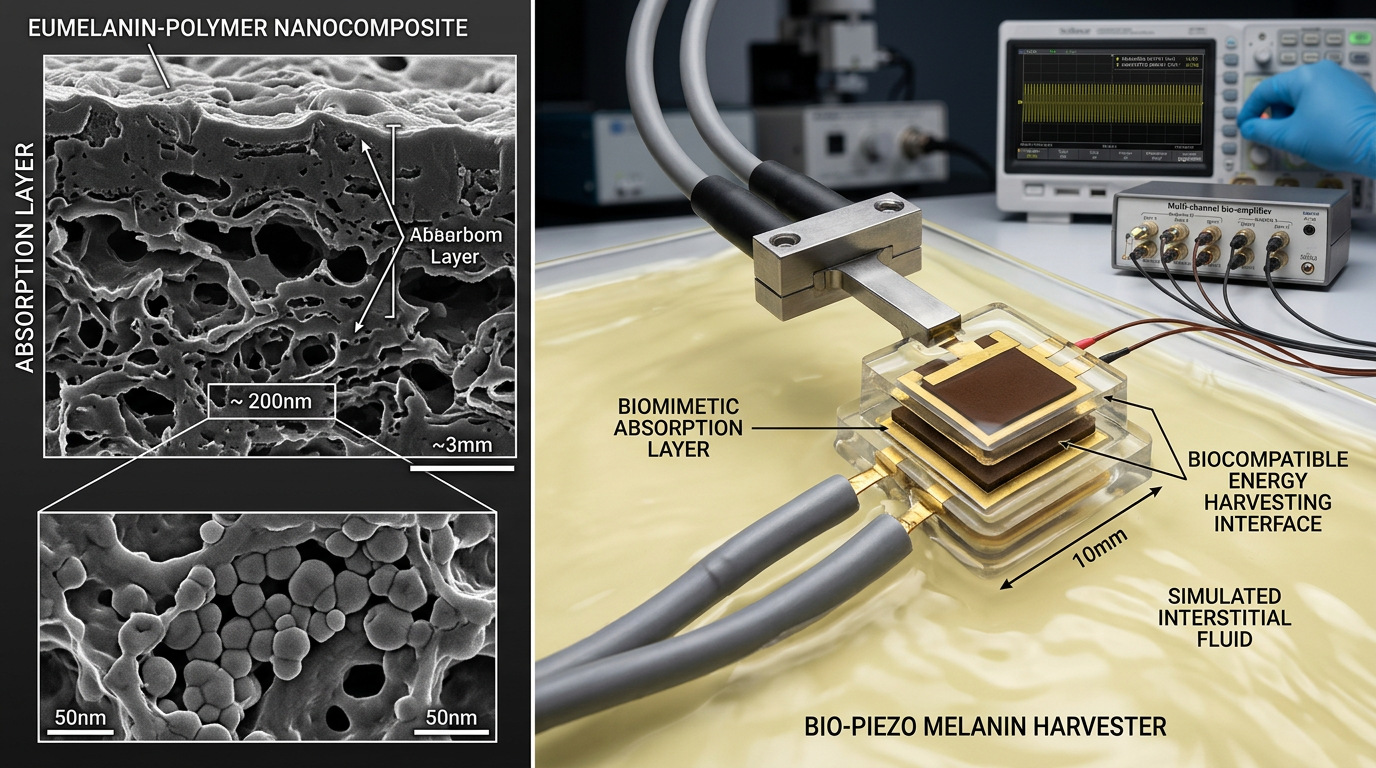
A speculative exploration of engineering nature's most efficient light absorber into wireless power sources for biomedical devices.
What if the same pigment that protects our skin from UV damage could one day eliminate the need for battery replacements in pacemakers, neural implants, and insulin pumps? This isn't science fiction—it's a logical extension of melanin's remarkable energy conversion properties that researchers are only beginning to understand.
Consider this: melanin absorbs over 99% of incident light across an extraordinarily broad spectrum, from ultraviolet through visible light and into the near-infrared. Unlike silicon solar cells that work efficiently only within narrow wavelengths, melanin captures virtually every photon that hits it. More intriguingly, recent studies have shown that hydrated melanin can convert this absorbed energy into electrical charge through mechanisms that remain partially mysterious. If we could engineer synthetic melanin films to harvest not just light but the full spectrum of electromagnetic energy surrounding our bodies—from ambient light to body heat to radiofrequency radiation—we might solve one of biomedical engineering's most persistent challenges: keeping implanted devices powered without invasive surgeries.
The Science We Know
Melanin's energy conversion capabilities rest on well-documented biophysical properties that make it unique among biological materials. John McGinness and colleagues at the University of Texas demonstrated in the 1970s that melanin exhibits semiconductor behavior with a bandgap of approximately 1.85 eV, positioning it perfectly to absorb visible light. More recently, researchers have measured melanin's broadband absorption coefficient exceeding 10^5 cm^-1 across the UV-visible spectrum—a value that rivals the best synthetic absorbers.
The conversion mechanism involves melanin's stable free radical population, detectable through electron paramagnetic resonance (EPR) spectroscopy. These unpaired electrons, estimated at one per 1000 monomer units in eumelanin, create a network of charge carriers throughout the polymer structure. When photons are absorbed, they promote electrons to higher energy states, generating mobile charge carriers that can contribute to electrical conductivity.
Critically, melanin's electrical properties are hydration-dependent. Dry melanin films show resistivity values around 10^12 ohm-cm, but hydrated samples can drop to 10^6 ohm-cm or lower. This occurs because water molecules facilitate proton conductivity alongside electronic conduction, creating what researchers describe as a "mixed ionic-electronic conductor." The hydration effect is so pronounced that melanin's conductivity can increase by six orders of magnitude simply by controlling moisture content.
Recent work by Arturo Solís Herrera has pushed these observations further, suggesting that melanin can dissociate water molecules when exposed to electromagnetic radiation, potentially generating electrical current through what he terms "human photosynthesis." While this specific mechanism remains controversial, the underlying observation—that melanin converts electromagnetic energy to electrical energy—is well-established.
The Possibility
If melanin's natural properties could be engineered and optimized, the path to ambient energy harvesting becomes clear through logical extrapolation. Consider the electromagnetic environment inside the human body: we're surrounded by infrared radiation from body heat (approximately 100 watts of thermal energy), ambient light penetrating tissue, and increasingly, radiofrequency energy from wireless devices and medical telemetry systems.
A synthetic melanin film engineered for maximum energy conversion could theoretically harvest from all these sources simultaneously. Unlike conventional photovoltaics that require direct sunlight, melanin's broadband absorption means it could generate power from the dim red light that penetrates tissue, the infrared glow of body heat, and even scattered radiofrequency energy from cell phones and WiFi networks.
The power requirements make this scenario plausible. Modern pacemakers consume approximately 10-15 microwatts during normal operation, with peak demands reaching 100 microwatts during pacing. Insulin pumps require roughly 50-100 microwatts continuously. Neural stimulators vary widely but many operate in the milliwatt range. If a melanin-based harvester covering just a few square centimeters could achieve even 1% efficiency in converting ambient electromagnetic energy to electricity, it could potentially meet these power demands.
The biocompatibility advantage is enormous. Melanin is naturally present in human tissue, particularly in the brain, skin, and inner ear. Unlike lithium batteries, which require hermetic sealing to prevent toxic leakage, or conventional solar cells containing potentially harmful semiconductors, melanin-based harvesters could integrate directly with biological tissue. They might even be designed to be biodegradable, eliminating the need for removal surgeries.
Challenges and Unknowns
Despite melanin's promising properties, significant scientific and engineering barriers remain. The most fundamental challenge is efficiency optimization. While melanin absorbs light exceptionally well, converting that absorbed energy to useful electrical current remains inefficient. Most absorbed photons generate heat rather than mobile charge carriers, and the mechanisms governing this conversion are still poorly understood.
The charge extraction problem is equally daunting. Even if melanin generates electrical charge efficiently, collecting that charge and delivering it to an implanted device requires sophisticated electrode designs and power management circuits. The interface between melanin films and conventional electronics remains largely unexplored, particularly in the wet, ionic environment of biological tissue.
Stability presents another major hurdle. Natural melanin in living organisms is constantly renewed through cellular metabolism. Synthetic melanin films would need to maintain their electrical properties for years or decades while exposed to the corrosive environment inside the human body. The hydration-dependent conductivity that makes melanin promising also makes it vulnerable to changes in local water content and ion concentrations.
We also lack fundamental understanding of melanin's structure-property relationships. Melanin is not a single compound but a complex mixture of polymers with varying molecular weights, cross-linking patterns, and dopant concentrations. Which specific structural features optimize energy conversion? How can we control melanin synthesis to maximize these features? These questions remain largely unanswered.
Finally, the regulatory pathway for such devices would be unprecedented. Current biomedical implants use well-characterized materials with decades of safety data. Melanin-based energy harvesters would require extensive biocompatibility testing, long-term stability studies, and new safety standards for electromagnetic energy harvesting in vivo.
The Path Forward
Realizing melanin-powered medical implants requires coordinated research across multiple disciplines. The immediate priority is fundamental materials science: understanding how melanin's molecular structure determines its electrical properties. This means developing controlled synthesis methods for melanin with defined molecular weights, cross-linking densities, and dopant concentrations, then systematically measuring how these parameters affect energy conversion efficiency.
Interface engineering represents the next critical challenge. Researchers need to develop electrode materials and geometries that efficiently extract charge from melanin films without degrading over time in biological environments. This likely requires new materials that can form stable, low-resistance contacts with hydrated melanin while remaining biocompatible.
Device integration studies should begin with simple proof-of-concept demonstrations: melanin films powering basic electronic circuits under simulated biological conditions. These experiments would reveal practical challenges in power management, energy storage, and device packaging that aren't apparent from materials studies alone.
Parallel biocompatibility research is essential. Even though melanin is naturally occurring, synthetic melanin films may have different biological interactions than endogenous melanin. Long-term implantation studies in animal models would be necessary to evaluate tissue responses, device stability, and any unexpected biological effects.
Finally, theoretical modeling could accelerate progress by predicting optimal device designs before expensive fabrication and testing. Computational models of electromagnetic energy absorption, charge transport, and heat generation in melanin-based harvesters could guide experimental efforts and identify the most promising approaches.
Key Takeaways
• Melanin naturally absorbs >99% of incident electromagnetic radiation across UV-visible-NIR wavelengths and converts absorbed energy to electrical charge through semiconductor-like mechanisms.
• Modern medical implants require only 10-100 microwatts of power, potentially within reach of optimized melanin-based energy harvesters covering a few square centimeters.
• Melanin's biocompatibility and hydration-dependent conductivity could enable direct integration with biological tissue, eliminating the need for hermetic device packaging.
• Major challenges include low energy conversion efficiency, unclear charge extraction mechanisms, and unknown long-term stability in biological environments.
• Realizing this technology requires fundamental advances in melanin synthesis, interface engineering, and biocompatibility testing across multiple research disciplines.
• Success could eliminate battery replacement surgeries for millions of patients while enabling new classes of wireless, permanently implanted medical devices.
References
McGinness, J., et al. "Amorphous Semiconductor Switching in Melanins." Science 183(4127), 853-855 (1974).
Meredith, P. & Sarna, T. "The Physical and Chemical Properties of Eumelanin." Pigment Cell Research 19(6), 572-594 (2006).
Wünsche, J., et al. "Protonic and Electronic Transport in Hydrated Thin Films of the Pigment Eumelanin." Chemistry of Materials 27(2), 436-442 (2015).
Mostert, A.B., et al. "Role of Semiconductivity and Ion Transport in the Electrical Conduction of Melanin." Proceedings of the National Academy of Sciences 109(23), 8943-8947 (2012).
Jastrzebska, M.M., et al. "Semiconductor Properties of Synthetic Dopa-Melanin." Journal of Biomaterials Science 6(7), 577-586 (1995).
Abbas, M., et al. "Structural, Electrical, Electronic and Optical Properties of Melanin Films." European Physical Journal E 28(3), 285-291 (2009).
Bridelli, M.G., et al. "Switching and Amplification in Melanin-Based Junctions." Journal of Applied Physics 50(12), 8052-8056 (1979).