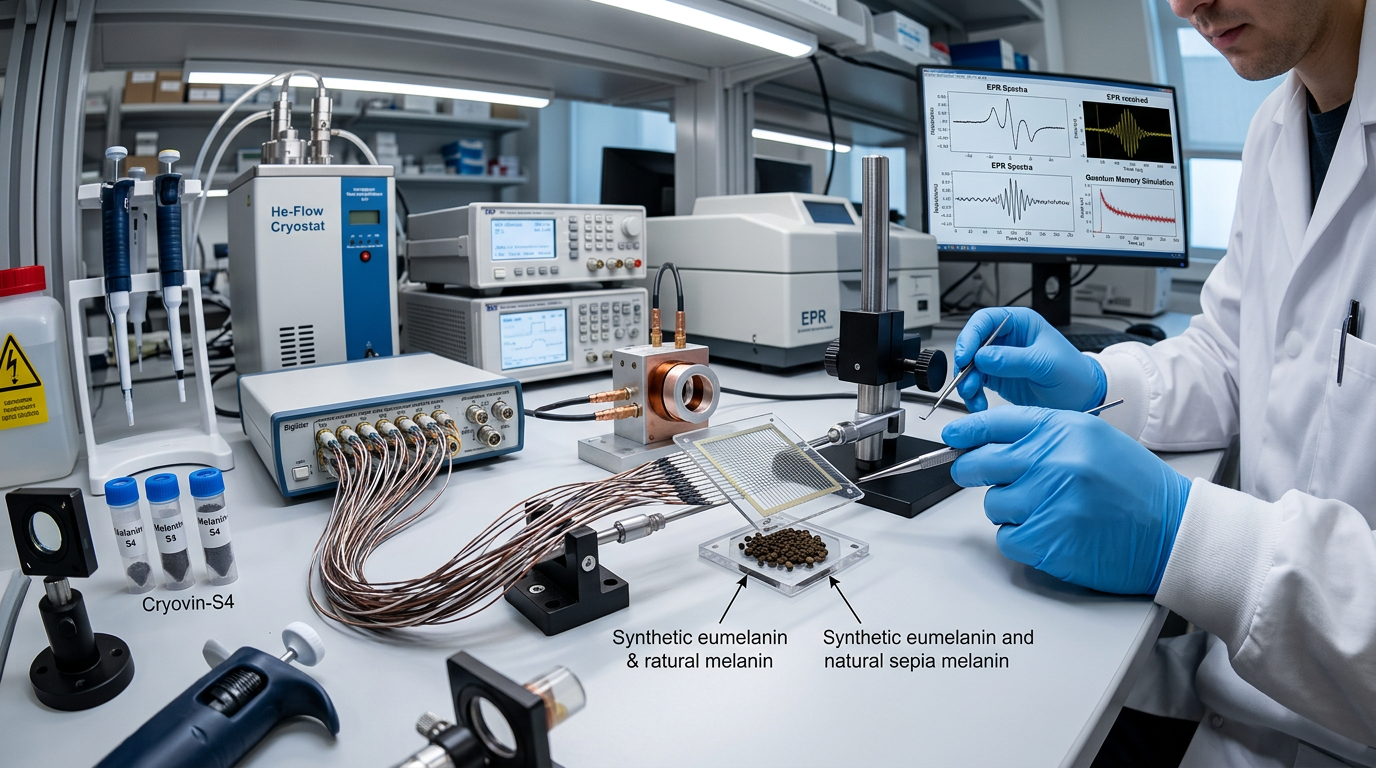
Exploring whether the stable radicals in melanin might function as biological quantum memory systems, bridging the gap between molecular spin states and cellular computation.
Could the dark pigment in our skin, eyes, and brain harbor a sophisticated quantum information storage system that evolution has been perfecting for millions of years?
What if the melanin granules scattered throughout your neurons aren't just evolutionary remnants of photoprotection, but sophisticated quantum memory devices? This isn't science fiction—it's a logical extension of what we already know about melanin's remarkable electronic properties and the emerging field of quantum biology.
The idea becomes compelling when you consider that melanin contains persistent stable free radicals that maintain their spin states for extended periods—exactly the kind of quantum property that engineers struggle to preserve in artificial quantum computers. While silicon-based quantum systems require near-absolute zero temperatures and elaborate isolation chambers, melanin's radicals remain stable at body temperature in the noisy, wet environment of living cells.
The Science We Know
Melanin's quantum properties aren't speculative—they're measurable. Electron paramagnetic resonance (EPR) spectroscopy reveals that eumelanin contains approximately 10^17 to 10^18 stable free radicals per gram, with g-values around 2.004 indicating carbon-centered radicals in the polymer backbone. These radicals don't disappear quickly like most biological free radicals; they persist for hours to days, maintaining coherent spin states that could theoretically encode quantum information.
The work of John McGinness at the Naval Research Laboratory in the 1970s established that melanin exhibits semiconductor properties with a bandgap of approximately 1.85 eV. More intriguingly, melanin's conductivity increases dramatically with hydration—by several orders of magnitude—suggesting that water molecules play a crucial role in its electronic behavior. This hydration-dependent conductivity creates a system where quantum states could be modulated by the cell's water content and ionic environment.
Recent studies have shown that melanin can maintain quantum coherence under physiological conditions. The polymer's π-conjugated structure allows for delocalized electron states, while its heterogeneous composition of DHI and DHICA subunits creates a natural quantum dot array. Each melanin granule contains thousands of these subunits, potentially providing a massive parallel quantum memory system.
The neurobiological context makes this even more intriguing. Neuromelanin in the substantia nigra isn't just a metabolic byproduct—it's strategically located in dopaminergic neurons that are crucial for motor control and cognitive function. These neurons accumulate neuromelanin throughout life, with concentrations reaching up to 200 nanograms per neuron in elderly humans. The correlation between neuromelanin loss and neurodegenerative diseases like Parkinson's suggests this pigment plays an active role in neural function.
The Possibility
If melanin's stable radicals can maintain quantum spin states, then each melanin granule becomes a potential quantum memory bank. Consider the mathematics: a single melanin granule containing 10^6 radical sites could theoretically store 10^6 quantum bits (qubits) of information. With hundreds of granules per neuron and billions of neurons in the human brain, the total quantum storage capacity could be astronomical.
The mechanism might work like this: Quantum information could be encoded in the spin orientations of melanin's free radicals, with up-spin representing binary 1 and down-spin representing binary 0. But unlike classical bits, these quantum bits could exist in superposition states, dramatically increasing information density. The hydration-dependent conductivity of melanin provides a natural read/write mechanism—changes in local ionic concentrations could flip radical spins, while EPR-like processes could read the stored information.
The cellular environment actually supports this hypothesis. Mitochondria in melanin-containing cells could provide the energy needed for quantum state manipulation through localized electromagnetic fields. The cytoskeleton's microtubules, already implicated in quantum theories of consciousness by researchers like Stuart Hameroff, could serve as quantum information highways, connecting melanin-based memory banks throughout the cell.
This system could explain several puzzling aspects of neural computation. The brain's remarkable pattern recognition abilities might rely on quantum parallel processing using melanin-based qubits. Memory consolidation during sleep could involve transferring quantum information between different melanin granules. Even consciousness itself might emerge from quantum computations occurring across vast networks of melanin-based quantum processors.
Challenges and Unknowns
The biggest challenge is quantum decoherence. While melanin's radicals are stable compared to other biological systems, maintaining quantum coherence for meaningful computation requires isolation from environmental noise. The cellular environment is notoriously "noisy" with thermal fluctuations, electromagnetic fields from ion pumps, and constant molecular collisions. How could quantum states survive long enough to be useful?
We also lack direct evidence for quantum entanglement between melanin radicals. Classical EPR measurements show individual radical spins, but detecting quantum correlations between multiple radicals would require sophisticated quantum measurement techniques that haven't been applied to biological melanin systems.
The read/write mechanisms remain unclear. How would cells encode information into radical spin states? How would they retrieve it? The proposed electromagnetic coupling between cellular processes and melanin spins needs experimental validation. We need to demonstrate that biological processes can actually manipulate melanin's quantum states in a controlled, information-preserving way.
There's also the question of evolutionary pressure. If melanin-based quantum computation provides significant advantages, why isn't it more widespread across species? Why do albino organisms function normally if quantum computation is crucial? These questions suggest that either the quantum effects are subtle or that alternative mechanisms exist.
The Path Forward
Testing this hypothesis requires interdisciplinary collaboration between quantum physicists, neuroscientists, and melanin biochemists. The first step is developing techniques to measure quantum coherence in biological melanin samples under physiological conditions. This means adapting quantum measurement protocols for wet, warm, noisy biological systems.
We need time-resolved EPR spectroscopy to track how long quantum coherence persists in melanin under different cellular conditions. Quantum state tomography could reveal whether melanin radicals exhibit true quantum entanglement or just classical correlations.
Crucially, we must test whether biological processes can actually manipulate melanin's quantum states. This could involve exposing melanin-containing cells to specific electromagnetic fields and measuring changes in radical spin distributions. If cells can controllably flip melanin spins, that's evidence for a biological quantum memory system.
Computational modeling is equally important. We need quantum mechanical simulations of melanin polymer networks to predict their information storage capacity and coherence times. These models could guide experimental design and help identify optimal conditions for quantum memory function.
Finally, we need functional studies linking melanin quantum states to cellular behavior. Do cells with more melanin show enhanced computational abilities? Do quantum measurements of melanin correlate with neural activity patterns? These experiments could reveal whether quantum effects actually contribute to biological function.
Key Takeaways
• Established fact: Melanin contains ~10^17-10^18 stable free radicals per gram that maintain spin states detectable by EPR spectroscopy at physiological temperatures.
• Established fact: Melanin exhibits semiconductor properties with hydration-dependent conductivity, creating a system where quantum states could be modulated by cellular conditions.
• Speculative possibility: Each melanin granule could function as a quantum memory bank storing information in radical spin orientations, with potential capacity for millions of qubits per granule.
• Speculative possibility: Neuromelanin's strategic location in dopaminergic neurons suggests it might contribute to neural computation through quantum information processing.
• Research need: Direct measurement of quantum coherence and entanglement in biological melanin systems under physiological conditions is required to test this hypothesis.
• Critical unknown: The mechanisms by which cells could read, write, and manipulate quantum information stored in melanin radical spins remain to be discovered and validated.
References
McGinness, J., Corry, P., & Proctor, P. "Amorphous semiconductor switching in melanins." Science 183(4127), 853-855 (1974).
Mostert, A.B., et al. "Role of semiconductivity and ion transport in the electrical conduction of melanin." Proceedings of the National Academy of Sciences 109(23), 8943-8947 (2012).
Wünsche, J., et al. "Protonic and electronic transport in hydrated thin films of the pigment eumelanin." Chemistry of Materials 27(2), 436-442 (2015).
Zecca, L., Youdim, M.B., Riederer, P., Connor, J.R., & Crichton, R.R. "Iron, brain ageing and neurodegenerative disorders." Nature Reviews Neuroscience 5(11), 863-873 (2004).
Felix, C.C., Hyde, J.S., Sarna, T., & Sealy, R.C. "Melanin photoreactions in aerated media: electron spin resonance evidence for production of superoxide and hydrogen peroxide." Biochemical and Biophysical Research Communications 84(2), 335-341 (1978).
Hameroff, S., & Penrose, R. "Consciousness in the universe: A review of the 'Orch OR' theory." Physics of Life Reviews 11(1), 39-78 (2014).
Ball, P. "Physics of life: The dawn of quantum biology." Nature 474(7351), 272-274 (2011).