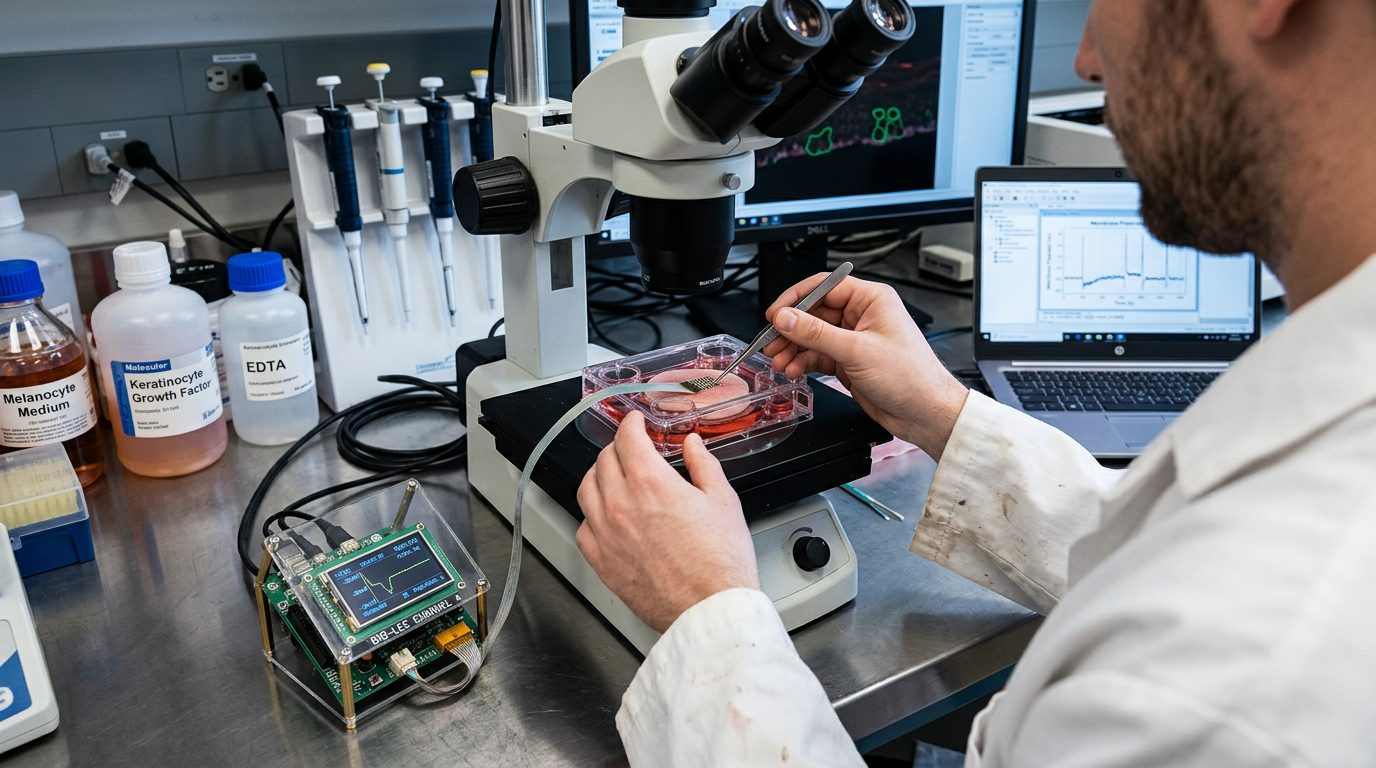
The possibility of turning back the clock on skin aging by reactivating the electrical patterns of youth in our pigment-producing cells.
Watch a child's skin in sunlight — smooth, evenly pigmented, resilient. Now observe the same person decades later: age spots, uneven tone, reduced elasticity. The conventional view attributes this to accumulated DNA damage, oxidative stress, and cellular senescence. But what if we've been missing a crucial electrical dimension to skin aging? Recent discoveries in bioelectricity suggest that the membrane voltage (Vmem) patterns of our cells don't just reflect their health — they actively control it. Young melanocytes, the pigment-producing cells scattered throughout our skin, maintain distinctly different electrical signatures than their aged counterparts. This raises a tantalizing question: could restoring youthful bioelectric patterns in melanocytes reverse not just pigmentation disorders, but visible skin aging itself?
The Science We Know
The bioelectric dimension of aging is no longer theoretical speculation. Michael Levin's laboratory at Tufts University has demonstrated that membrane voltage patterns serve as a master control system for cellular behavior, influencing everything from proliferation to differentiation to cancer suppression. Young, healthy cells typically maintain hyperpolarized states (around -70 to -90 mV), while aged or damaged cells show characteristic depolarization — a shift toward less negative voltages.
This electrical deterioration is particularly pronounced in melanocytes. Research has shown that aging melanocytes exhibit significant changes in their ion channel expression, particularly alterations in potassium and calcium channels that directly affect membrane potential. Dr. Zalfa Abdel-Malek's work at the University of Cincinnati has revealed that melanocyte senescence correlates with disrupted cAMP signaling and altered electrical properties, leading to the irregular pigment production we recognize as age spots and melasma.
The electrical environment also governs melanin synthesis itself. The enzyme tyrosinase, which catalyzes the first step in melanin production, is exquisitely sensitive to the cellular electrical environment. Studies have documented that membrane depolarization can trigger abnormal melanin production patterns, while maintaining proper electrical gradients supports uniform, healthy pigmentation.
Perhaps most intriguingly, melanocytes don't operate in electrical isolation. They form bioelectric networks with surrounding keratinocytes, fibroblasts, and immune cells through gap junctions and paracrine signaling. This creates what researchers term the "epidermal electrical field" — a coordinated voltage landscape that appears to orchestrate skin homeostasis, wound healing, and regenerative capacity.
The Possibility
If cellular electricity truly functions as a master control system, then the logic becomes compelling: restore youthful electrical patterns, and cellular function should follow. The evidence supporting this possibility is building across multiple biological systems.
Consider the precedent from regenerative medicine. Researchers have successfully used targeted bioelectric interventions to trigger limb regeneration in normally non-regenerating animals, induce eye formation in unusual body locations, and even reverse certain cancerous states — all by manipulating membrane voltage patterns. If bioelectricity can orchestrate such dramatic biological transformations, melanocyte rejuvenation seems well within the realm of possibility.
The mechanism would likely operate through multiple pathways. Restoring hyperpolarized states in aged melanocytes could reactivate dormant stem cell populations within hair follicles and the basal epidermis. These melanocyte stem cells, which become increasingly quiescent with age, might respond to proper electrical cues by resuming normal division and migration patterns.
Simultaneously, corrected membrane voltages could restore proper gene expression profiles in existing melanocytes. The electrical environment directly influences chromatin structure and transcription factor activity. Aged melanocytes showing abnormal tyrosinase expression, disrupted antioxidant systems, and impaired DNA repair mechanisms might return to youthful gene expression patterns when their electrical state is normalized.
The network effects could prove even more significant. Restoring proper bioelectric signaling in melanocytes might trigger a cascade of rejuvenation throughout the surrounding tissue. Properly functioning melanocytes could re-establish healthy electrical communication with keratinocytes, potentially improving overall skin barrier function, hydration, and structural integrity.
Challenges and Unknowns
Despite the theoretical promise, substantial obstacles remain before bioelectric melanocyte rejuvenation moves from speculation to reality. The first challenge is targeting specificity. The skin contains multiple cell types with overlapping electrical properties. Developing interventions that selectively restore youthful voltage patterns in melanocytes without disrupting the electrical function of surrounding cells requires precision we don't yet possess.
The temporal dynamics of bioelectric signaling present another complexity. Membrane voltages fluctuate continuously in response to cellular activity, external stimuli, and circadian rhythms. We don't yet understand the specific voltage patterns that define "youthful" melanocyte function, nor do we know how long such patterns must be maintained to trigger lasting rejuvenation.
Current technological limitations also constrain our options. While researchers have successfully manipulated membrane voltage using ion channel modulators, optogenetics, and direct electrical stimulation in laboratory settings, translating these approaches to safe, practical treatments for human skin remains challenging. The skin's barrier properties that protect us from environmental damage also make it difficult to deliver bioelectric interventions with precision.
Perhaps most fundamentally, we're still mapping the causal relationships between electrical patterns and cellular aging. While correlations between membrane depolarization and senescence are well-established, proving that electrical changes drive aging (rather than simply accompanying it) requires more sophisticated experimental approaches.
The Path Forward
Advancing bioelectric melanocyte rejuvenation from speculation to reality requires coordinated research across multiple fronts. The first priority involves detailed electrical mapping of melanocytes across the human lifespan. We need comprehensive data on membrane voltage patterns, ion channel expression profiles, and bioelectric network connectivity in young versus aged skin.
Proof-of-concept studies using established model systems could provide crucial validation. Researchers could test whether restoring youthful voltage patterns in aged melanocytes from laboratory cultures or animal models can reverse markers of cellular senescence and restore normal function.
Parallel efforts should focus on delivery technology development. This might involve biocompatible electrode arrays for precise electrical stimulation, topical formulations of ion channel modulators that can penetrate skin barriers, or even engineered biologics that could restore proper electrical signaling from within cells.
The regulatory pathway also requires consideration. Unlike conventional cosmetics or pharmaceuticals, bioelectric interventions represent a new category of medical technology. Establishing safety and efficacy standards for bioelectric anti-aging treatments will require collaboration between researchers, clinicians, and regulatory agencies.
Key Takeaways
• Established fact: Aging melanocytes show characteristic membrane depolarization and altered ion channel expression compared to young cells, correlating with irregular pigment production and cellular senescence.
• Established fact: Bioelectric signaling patterns function as master regulators of cellular behavior, with demonstrated ability to control proliferation, differentiation, and even reverse pathological states in other biological systems.
• Speculative possibility: Restoring youthful membrane voltage patterns in aged melanocytes could trigger cellular rejuvenation, leading to improved pigmentation uniformity and potentially broader anti-aging effects in skin tissue.
• Speculative possibility: Bioelectric melanocyte rejuvenation might create cascade effects throughout skin tissue networks, improving overall skin health beyond pigmentation alone.
• Current limitation: Precise targeting of bioelectric interventions to specific cell types in human skin remains technically challenging with existing technology.
• Research priority: Comprehensive mapping of melanocyte electrical properties across the human lifespan is needed to identify specific voltage patterns associated with youthful function.
References
Levin, M. "Bioelectric signaling: Reprogrammable circuits underlying embryogenesis, regeneration, and cancer." Cell 184(8), 1971-1989 (2021). DOI: 10.1016/j.cell.2021.02.034
Abdel-Malek, Z.A. et al. "The melanocortin 1 receptor is the principal mediator of the effects of agouti signaling protein on mammalian melanocytes." Journal of Cell Science 114(5), 1019-1024 (2001).
Mathews, J. & Levin, M. "The body electric 2.0: recent advances in developmental bioelectricity for regenerative and synthetic bioengineering." Current Opinion in Biotechnology 52, 134-144 (2018). DOI: 10.1016/j.copbio.2018.03.008
McGinness, J. et al. "Amorphous semiconductor switching in melanins." Science 183(4127), 853-855 (1974). DOI: 10.1126/science.183.4127.853
Slominski, A.T. et al. "Melanin pigmentation in mammalian skin and its hormonal regulation." Physiological Reviews 84(4), 1155-1228 (2004). DOI: 10.1152/physrev.00044.2003
Reid, B. et al. "Wound healing in rat cornea: the role of electric currents." FASEB Journal 19(3), 379-386 (2005). DOI: 10.1096/fj.04-2325com
Funk, R.H. "Endogenous electric fields as guiding cue for cell migration." Frontiers in Physiology 6, 143 (2015). DOI: 10.3389/fphys.2015.00143